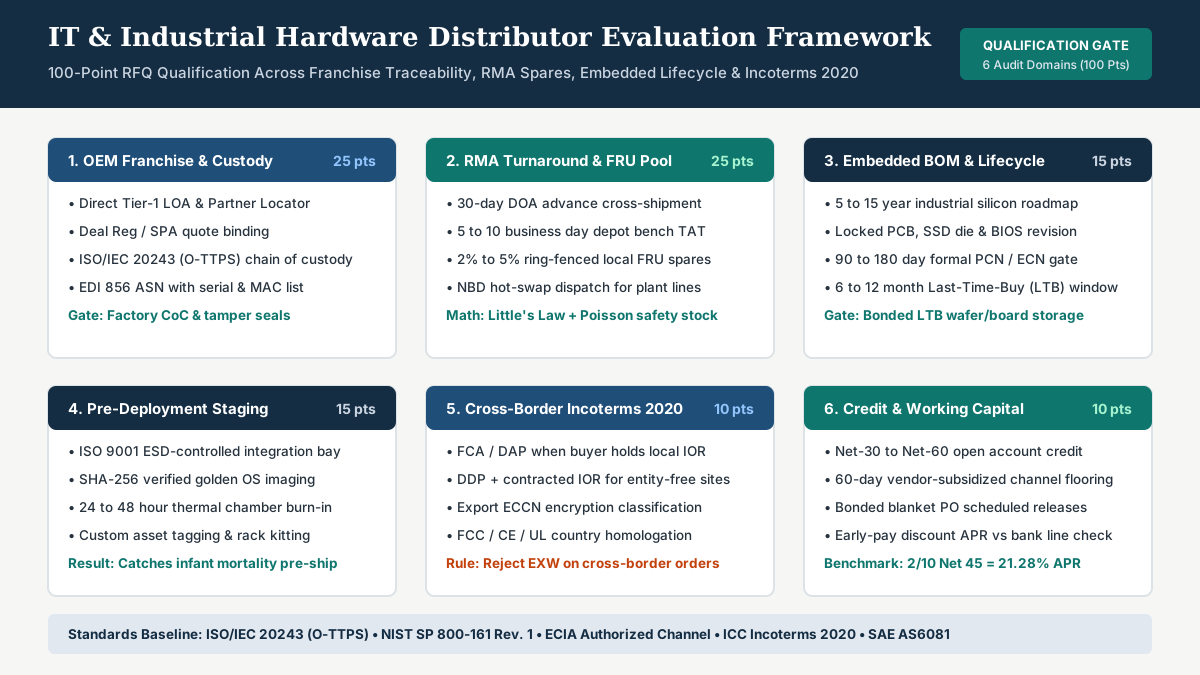
Awarding a multi-site hardware roll-out to an unvetted IT hardware distributor risks voided factory warranties, counterfeit boards, customs holds, and weeks of unscheduled plant downtime when a terminal fails. Qualifying an IT hardware distributor or industrial computing distributor requires auditing six verifiable records before issuing a purchase order: direct OEM franchise status, ISO/IEC 20243 (O-TTPS) serial chain of custody, Dead-on-Arrival (DOA) and depot Return Material Authorization (RMA) turnaround, embedded Bill of Materials (BOM) revision locks, pre-deployment staging gates, and cross-border Incoterms 2020 and credit terms.
On the U.S. International Trade Administration (ITA) representative due-diligence checklist, a buyer or manufacturer evaluating a channel partner verifies territory coverage, competing product lines, sales force technical qualification, warehouse inventory controls, and local repair-part stocking before signing an appointment or supply contract. Related procurement and trade explainers appear in the Business section.
| Evaluation domain | Commercial broadline baseline | Industrial computing VAD target | Primary audit evidence required |
|---|---|---|---|
| OEM franchise & pricing | Direct Tier-1 commercial OEM franchise; automated EDI for Deal Registration and Special Pricing Authorization (SPA) | Direct embedded/industrial OEM franchise; Design-Win registration locking project BOM pricing across multi-year roll-outs | Live OEM Partner Locator entry, dated Letter of Authorization (LOA), and SPA quote code |
| Supply chain security | Standard factory carton barcoding and commercial invoice serialization | ISO/IEC 20243 and NIST SP 800-161 Rev. 1 serial/MAC Advance Shipping Notice (ASN) plus OEM Certificate of Conformance (CoC) | EDI 856 or CSV ASN with chassis serials, MAC addresses, build dates, and tamper-seal audit |
| DOA & field RMA SLA | 14 to 30 day invoice-dated DOA return window; 10 to 21 business day mail-in OEM depot repair unless NBD support pack is bought | 30-day delivery-dated DOA cross-shipment (24 to 48 hr dispatch); 5 to 10 business day regional depot TAT or NBD FRU pool swap | Written RMA SLA annex defining DOA start trigger, bench TAT vs door-to-door days, and ring-fenced 2% to 5% FRU pool |
| Lifecycle & BOM lock | 9 to 18 month SKU refresh; silent component swaps under rolling part numbers; 30 to 90 day End-of-Life (EOL) notice | 5 to 15 year embedded processor roadmap; locked PCB/BIOS/SSD revision matrix; 90 to 180 day PCN and 6 to 12 month Last-Time-Buy (LTB) notice | Signed Hardware Revision Matrix and contractual 5-day pass-through of OEM PCN/LTB bulletins |
| Staging & burn-in | High-volume warehouse asset tagging and basic Windows Autopilot registration | ISO 9001 ESD integration bay: RAM/SSD kitting, SHA-256 verified golden OS imaging, and 24 to 48 hour thermal chamber burn-in | Integration center ISO 9001 certificate and batch burn-in pass/fail telemetry log |
| Trade & credit terms | Domestic drop-ship or FCA warehouse; Net-30 to Net-60 open account and channel flooring lines | Multi-region FCA, DAP, or DDP with contracted Importer of Record (IOR); bonded blanket PO inventory holding over 6 to 12 months | Incoterms 2020 clause, IOR tax registration, ECCN export filing, and credit/flooring schedule |
How the two-tier IT and industrial hardware distribution channel works
The enterprise and industrial hardware distribution channel separates bulk factory aggregation, technical pre-configuration, on-site integration, and secondary surplus trading into four distinct commercial archetypes. While how small manufacturers build international sales channels maps the foundational split between commission agents, stocking distributors, trading houses, and fulfilment warehouses across general manufacturing, the IT and industrial computing hardware channel enforces strict two-tier franchise boundaries around warranty entitlement, firmware access, and project pricing.
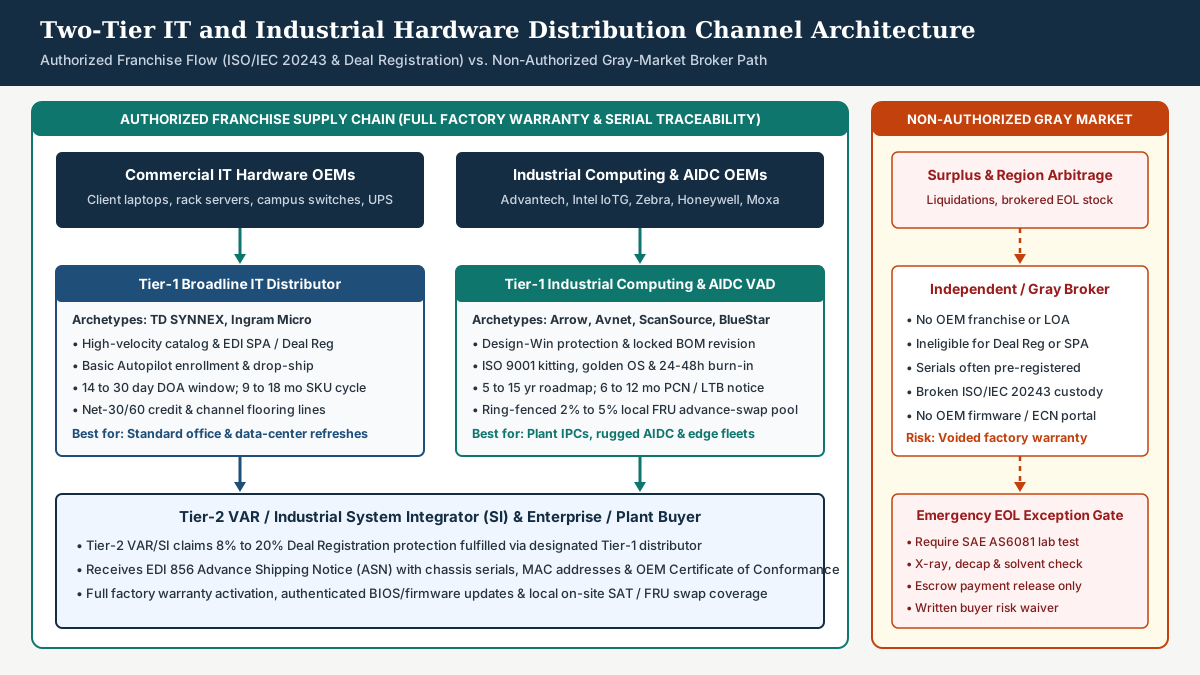
In a two-tier hardware distribution channel, Original Equipment Manufacturers (OEMs) such as Dell, HPE, Cisco, Advantech, Zebra, Honeywell, and Moxa sell through Tier-1 distributors rather than fulfilling fragmented orders directly to thousands of regional integrators. Tier-1 Broadline IT Distributors (exemplified by TD SYNNEX and Ingram Micro) aggregate high-velocity commercial client laptops, enterprise rack servers, campus switches, and uninterruptible power supplies (UPS). Their operations prioritize automated Electronic Data Interchange (EDI) pricing feeds, rapid drop-shipment from central logistics hubs, and high-limit credit facilities.
Tier-1 Industrial Computing and Specialty Automated Identification and Data Capture (AIDC) Value-Added Distributors (VADs), such as Arrow Electronics, Avnet, ScanSource, and BlueStar, manage lower-volume, high-reliability hardware built for harsh environments: fanless DIN-rail industrial PCs (IPCs), IP65-rated Human-Machine Interface (HMI) panel PCs, rugged barcode terminals, RFID readers, and cellular edge gateways. According to the Electronic Components Industry Association (ECIA), authorized franchise distributors maintain direct factory inventory feeds, electrostatic discharge (ESD) and moisture sensitivity level (MSL) warehouse controls, factory Certificates of Conformance (CoC), and formal engineering change tracking.
Tier-2 Value-Added Resellers (VARs) and Industrial System Integrators (SIs) purchase hardware from Tier-1 broadline distributors or VADs, combine those units with Programmable Logic Controller (PLC) or Manufacturing Execution System (MES) software, build plant enclosures, and perform on-site Factory Acceptance Testing (FAT) and Site Acceptance Testing (SAT). Outside the authorized franchise network sit independent or gray-market brokers who trade allocated, obsolete, or surplus factory-sealed stock across regional price boundaries without an OEM contract.
| Channel tier and archetype | Primary hardware scope | OEM franchise and pricing access | Pre-deployment staging and engineering | RMA and lifecycle continuity | Credit and working capital terms |
|---|---|---|---|---|---|
| Tier-1 Broadline IT Distributor (e.g., TD SYNNEX, Ingram Micro) | Commercial laptops, desktops, monitors, enterprise rack servers, standard campus switches, UPS units, and commercial software | Direct Tier-1 OEM franchise; automated EDI/API feeds for Deal Registration, Special Pricing Authorization (SPA), and Public Sector pricing | High-volume warehouse configuration: basic BIOS asset tagging, Windows Autopilot zero-touch enrollment, and palletized drop-shipment | Standard 14 to 30 day DOA return rules (often with open-box restocking caps); relies on OEM direct support packs for field NBD replacement; 9 to 18 month SKU refresh | High-limit Net-30 to Net-60 open account lines, channel flooring programs (such as DLL or CDF), and credit-insured multi-currency invoicing |
| Tier-1 Industrial Computing & Specialty AIDC VAD (e.g., Arrow, Avnet, ScanSource, BlueStar) | Industrial PCs (IPCs), fanless DIN-rail box PCs, IP65 panel PCs, COM Express boards, rugged barcode scanners, RFID readers, and edge gateways | Direct OEM franchise for embedded and industrial lines; project Design-Win registration locking BOM pricing across multi-year roll-outs | Dedicated ISO 9001 integration centers: custom industrial SSD/RAM assembly, golden Linux/Windows IoT imaging, BIOS revision locking, and 24 to 48 hour thermal burn-in | 5 to 15 year embedded processor roadmap alignment; proactive 6 to 12 month PCN and Last-Time-Buy (LTB) alerts; bonded buffer stock and local 2% to 5% FRU advance-swap pools | Net-30 to Net-60 open account, milestone billing for custom IPC assemblies, and bonded inventory holding agreements (scheduled blanket PO releases over 6 to 12 months) |
| Tier-2 Value-Added Reseller (VAR) / Industrial System Integrator (SI) | Turnkey site deployments combining IPC/AIDC hardware sourced from Tier-1 VADs with PLC/MES integration, enclosure wiring, and wireless site surveys | Gold/Platinum OEM partner tier; claims Deal Registration (typically 8% to 20% front-end discount protection or back-end rebate) fulfilled through a Tier-1 distributor | Site-specific staging: loads plant SCADA/MES client configurations, prints physical rack and machine labels, and executes FAT and SAT sign-offs | Provides first-line L1/L2 helpdesk and on-site field swap technician; holds local consignment or 2% to 5% FRU hot-swap spares on site while routing failed units to the VAD depot | Progress billing (for example, 30% on PO, 50% on hardware delivery/FAT, 20% on SAT sign-off) or Net-30 to Net-45 trade terms |
| Independent / Gray-Market Broker (Non-Authorized Open Market) | Allocated, obsolete, End-of-Life (EOL), or surplus factory-sealed IT and industrial hardware sourced from secondary liquidations or cross-region arbitrage | No OEM franchise agreement; ineligible for Deal Registration, SPA pricing, or OEM factory rebates; serial numbers are frequently pre-registered to a prior buyer or foreign region | No OEM-sanctioned firmware access; requires independent counterfeit mitigation screening under SAE AS6081 (visual inspection, X-ray, heated solvent test, and burn-in) | OEM factory warranty is typically voided upon unauthorized resale; buyer relies on a broker house warranty (30 days to 1 year) with zero access to official OEM engineering change notices | Prepayment (wire transfer in advance), third-party escrow release upon inspection, or Net-15/Net-30 terms for vetted accounts |
Rule of thumb: If a hardware deployment requires locked BIOS revisions, custom OS imaging, or multi-year spare-parts continuity across plant locations, contract through a Tier-1 industrial computing VAD or a Tier-2 system integrator backed by a VAD rather than a commercial broadline catalog distributor.
Takeaway: Match the distributor tier to the operational lifecycle of the endpoint: commercial broadline distributors optimize price and credit velocity on 12-month office refreshes, whereas industrial VADs protect 5 to 15 year plant floor standardization.
Verifying OEM authorization, deal registration, and chain of custody
An supplier quotation that prints an OEM logo on the letterhead does not prove that the seller holds an active franchise for that specific product family or delivery country. Under NIST SP 800-161 Rev. 1 (Update 1), organizations acquiring information and operational technology hardware must purchase exclusively from OEM-authorized distributors or resellers, validate cryptographic firmware signatures before deployment, and maintain component provenance records.
Complementing NIST controls, The Open Group Open Trusted Technology Provider Standard (O-TTPS), adopted as ISO/IEC 20243, establishes physical and logical supply-chain security requirements for Commercial Off-The-Shelf (COTS) ICT hardware providers and distributors. ISO/IEC 20243 requires documented chain-of-custody tracking from factory assembly through distribution warehousing, tamper-evident packaging seals, authorized component sourcing, and physical quarantine of defective RMA scrap so returned boards cannot re-enter sellable stock.
When a distributor sources from multiple upstream sub-tier assembly sites or regional hubs, procurement teams should also log the actual manufacturing plant and transit gateway using the supply chain concentration risk worksheet so two backup distributors do not fail simultaneously from the same upstream bottleneck.
| Verification gate | Controlling standard or source | Documentary evidence required before PO award | Dominant failure mode prevented |
|---|---|---|---|
| 1. Direct OEM Franchise & Partner Locator Match | NIST SP 800-161 Rev. 1 & ECIA Authorized Channel Standards | Live listing on the OEM’s official Partner/Distributor Locator for the exact country of delivery, plus a dated OEM Letter of Authorization (LOA) naming the distributor’s legal entity and product family | Blocks shadow brokering, where a reseller authorized in one region or product line sources tight SKUs from an unauthorized gray-market trader |
| 2. Deal Registration / Special Pricing Authorization (SPA / PE) Binding | Two-Tier Channel Commercial Practice & ITA Agreement Guidelines | OEM-issued Deal Registration ID or SPA quote number printed on the distributor’s quotation, displaying the locked end-user legal name, approved SKU quantities, and price-validity expiration date | Prevents mid-rollout price hikes, cross-border channel poaching, and OEM audit rejection of back-end rebate claims |
| 3. Serial Number, MAC Address & Certificate of Conformance (CoC) Traceability | ISO/IEC 20243 (O-TTPS) & NIST SP 800-161 Rev. 1 | Advance Shipping Notice (ASN) in EDI 856 or CSV format listing parent carton IDs, individual chassis serial numbers, Ethernet/Wi-Fi MAC addresses, factory build dates, and OEM Certificate of Conformance (CoC) | Stops region-locked hardware, previously activated serial numbers whose OEM warranty clock started months earlier, and counterfeit or remarked assemblies |
| 4. Tamper-Evident Packaging, Firmware Integrity & Quarantine Controls | ISO/IEC 20243 (O-TTPS) Physical Supply Chain & Malware Mitigation Sections | O-TTPS or ISO 9001 quality manual excerpt confirming factory tamper-evident seals, cryptographic SHA-256 hash verification of pre-loaded OS/BIOS images, and physical segregation of RMA scrap from new inventory | Prevents tainted firmware injection during warehouse staging and blocks defective returned boards from being repacked as new units |
| 5. Emergency EOL / Allocated Component Broker Inspection Protocol | ECIA & SAE AS6081 Counterfeit Electronic Parts Avoidance Standard | When an obsolete LTB part must be sourced outside franchise channels: SAE AS6081 lab certification, lot-specific X-ray and decapsulation test reports, third-party escrow payment terms, and written buyer risk waiver | Isolates emergency maintenance purchases from standard production procurement and verifies physical die authenticity before line installation |
Rule of thumb: Reject any distributor quote where the seller refuses to disclose the OEM Deal Registration / SPA reference number or cannot commit to delivering a pre-shipment EDI 856 / CSV serial-number ASN backed by an OEM Certificate of Conformance.
Takeaway: Verify franchise authorization by country and product line directly in the OEM portal before comparing unit discounts; an unauthorized 10% price cut forfeits the factory warranty and violates NIST SP 800-161 supply-chain controls.
Auditing RMA turnaround, local FRU spares, and embedded lifecycle SLAs
Office laptops and industrial computing terminals experience fundamentally different failure economics. When a corporate laptop fails, an employee can borrow a loaner while waiting for mail-in warranty service; when an IP65 panel PC, DIN-rail IPC, or unattended kiosk controller stops on a packaging line or retail lane, production or transaction throughput halts immediately. Evaluating how field hardware telemetry and watchdog timers reduce dispatch delays is covered in self-service kiosk systems and remote fleet management, specifying inline camera controllers and PLC reject handoffs is detailed in machine vision inspection line handoff, and balancing scheduled replacement against breakdown repair is detailed in predictive vs preventive maintenance cost analysis.
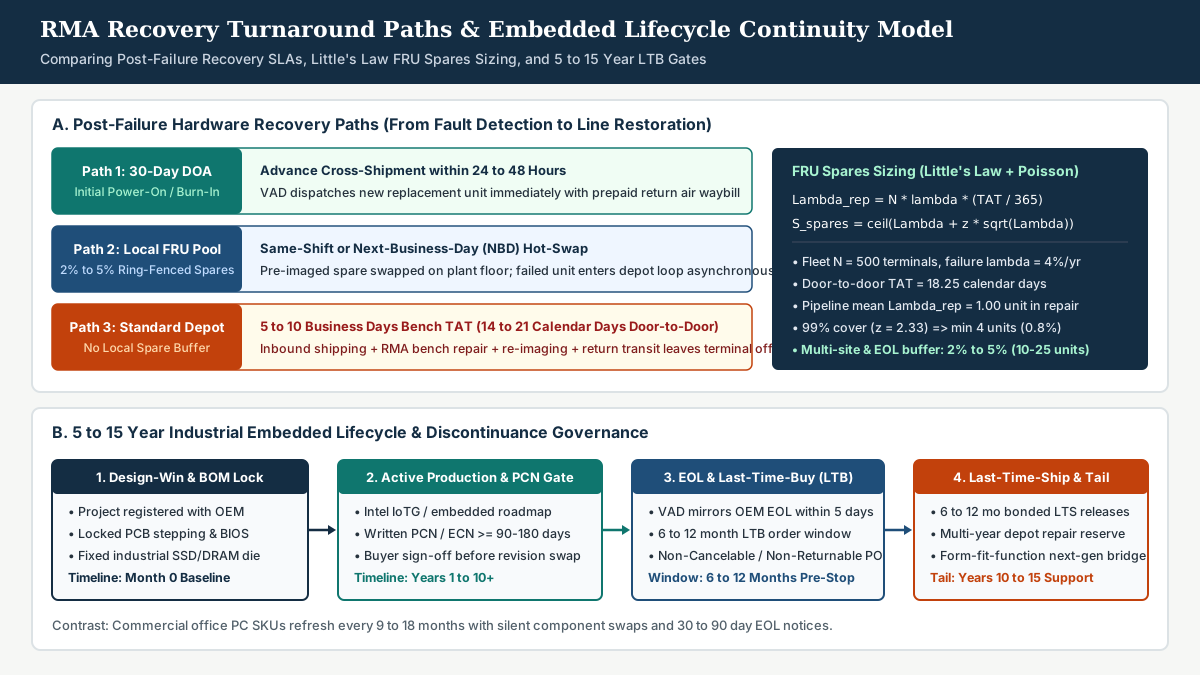
As documented in the Advantech Global RMA and Warranty Service Policy and ECIA industrial distribution guidelines, industrial computing warranties divide post-shipment failures into three distinct operational regimes:
- Initial Dead-on-Arrival (DOA) cross-shipment: When a newly delivered IPC, panel PC, or rugged scanner fails during initial receiving inspection or within the first 30 calendar days, an industrial VAD executes an advance replacement cross-shipment within 24 to 48 hours and issues a prepaid return air waybill.
- In-warranty depot repair Turnaround Time (TAT): After the DOA window closes, standard factory or regional service center depot repair typically requires 5 to 10 business days of bench turnaround (compared with 10 to 21 business days on commercial mail-in warranties), plus round-trip freight and customs clearance.
- Local Field Replaceable Unit (FRU) advance-exchange pools: Because a 5 to 10 business day bench TAT still translates into 14 to 21 calendar days of total door-to-door absence once shipping and re-imaging are added, multi-site plant deployments require a ring-fenced local FRU hot-swap pool equal to 2% to 5% of the deployed fleet.
| Service dimension | Commercial broadline baseline | Industrial VAD target SLA | Contract audit clause to require |
|---|---|---|---|
| Dead-on-Arrival (DOA) window & remedy | 14 to 30 calendar days from distributor invoice date; requires pristine original packaging; processed as credit-and-rebill or standard replacement if stock exists | 30 calendar days from buyer dock delivery or staging burn-in completion; priority Advance Replacement cross-shipped within 24 to 48 hours with prepaid return shipping | Define whether the 30-day DOA clock starts at distributor warehouse dispatch (FCA) or buyer dock receipt / burn-in sign-off |
| In-warranty field failure Turnaround Time (TAT) | Relies on OEM direct warranty; standard mail-in depot repair TAT is 10 to 21 business days unless the buyer purchases an OEM Next-Business-Day (NBD) support pack | Standard regional RMA depot repair TAT of 5 to 10 business days on the bench, or contracted NBD Advance Exchange dispatched from a local VAD FRU pool | Specify whether TAT measures depot dock-to-dock bench hours only, or total door-to-door elapsed days including customs clearance on cross-border returns |
| Local Field Replaceable Unit (FRU) spares buffer | 0% dedicated buffer; inventory sits in a shared national commercial pool sold first-come, first-served | 2% to 5% of the deployed fleet held as bonded, pre-imaged hot-swap spares (complete box PCs, touchscreens, power supplies, scan engines) at the VAD hub or plant site | Require serialized ring-fencing of the 2% to 5% FRU pool so distributor sales reps cannot allocate maintenance spares to new customer orders |
| Embedded BOM revision lock & PCN / ECN gate | None; commercial SKUs silently swap Wi-Fi cards, SSD controllers, or motherboard steppings under the same or rolling part number | Fixed BOM revision control (locked BIOS, PCB stepping, and industrial SSD/DRAM die) with mandatory written Product Change Notification (PCN) at least 90 to 180 days before any form, fit, or function change | Attach a locked Hardware Revision Matrix; require written buyer re-qualification sign-off before the distributor ships a newer PCB or firmware revision |
| Product longevity, Last-Time-Buy (LTB) & Last-Time-Ship (LTS) | 9 to 18 month active commercial sales window; 30 to 90 day End-of-Life (EOL) notice with limited final inventory | 5 to 15 year embedded silicon roadmap (aligned with Intel IoTG and industrial SBC lifecycles); formal EOL / LTB notice at least 6 to 12 months before final order date, plus 6 to 12 month Last-Time-Ship window | Obligate the distributor to mirror all OEM LTB bulletins within 5 business days and provide bonded warehouse storage for final lifetime-buy board allocations |
Sizing the local FRU spare-parts buffer with Little’s Law
To verify whether a distributor’s proposed spare-parts pool prevents line stoppages during depot repair cycles, procurement engineers model the active repair pipeline using Little’s Law combined with a normal-approximated Poisson safety stock bound:
Lambda_repair = N_fleet * lambda_annual * (TAT_days / 365)
S_spares = ceil(Lambda_repair + z * sqrt(Lambda_repair))
In this calculation:
N_fleetis the total number of active deployed hardware terminals across plant or retail sites.lambda_annualis the expected annual hardware failure rate expressed as a decimal (for example,0.04for a 4% annual field failure rate on industrial terminals).TAT_daysis the mean door-to-door turnaround time in calendar days to ship a failed unit to the depot, complete bench repair and re-imaging, and return it to the site.Lambda_repairis the average number of units simultaneously in the repair loop at any given time.zis the standard normal safety factor for the target stockout protection level under Poisson failure arrivals (z = 2.33for approximately 99% stockout protection).
Worked example: Consider a conditional calculation example for a manufacturing and logistics operator deploying N_fleet = 500 rugged panel PCs and barcode terminals experiencing an annual field failure rate of lambda_annual = 0.04 (20 unit failures per year). Under a standard 10 business day depot bench SLA plus outbound/inbound transit and re-imaging, the mean door-to-door turnaround is TAT_days = 18.25 calendar days (0.05 year). Applying Little’s Law yields the average number of units simultaneously in repair:
Lambda_repair = 500 * 0.04 * (18.25 / 365) = 1.00 unitBecause hardware failures cluster randomly during thermal spikes or shift changes, holding only 1 spare unit leaves the plant exposed whenever 2 or more units fail within the same 18.25-day repair window. Sizing a centralized hot-swap pool for a 99% service level (z = 2.33) requires:
S_spares = ceil(1.00 + 2.33 * sqrt(1.00)) = ceil(3.33) = 4 units (0.8% minimum pipeline cover)When those 500 terminals are split across multiple regional plants that cannot share a single shelf within 4 hours, or when the buyer must also cover non-repairable physical damage and End-of-Life attrition over a 7-year operating life, multiplying the base pipeline cover across site pools brings the practical industrial FRU buffer requirement to 2% to 5% of the deployed fleet (10 to 25 ring-fenced spare units for a 500-unit roll-out). The exact spare count for any specific contract depends on the fleet’s observed failure rate, site count, and contracted depot turnaround time.
Rule of thumb: Whenever door-to-door depot RMA turnaround exceeds 10 calendar days and plant downtime costs exceed the price of a spare terminal within a single shift, mandate a ring-fenced 2% to 5% local FRU advance-exchange buffer in the distributor agreement.
Takeaway: Audit depot TAT in calendar days from fault report to re-imaged unit arrival on site, and lock BOM revisions with a 90 to 180 day PCN gate so replacement spares match the deployed production image.
Cross-border Incoterms 2020, pre-deployment staging, and credit terms
When an enterprise or manufacturer deploys pre-configured IT and industrial computing hardware across international plants, the distributor contract must synchronize two handoffs: technical pre-deployment staging inside the distributor’s integration center, and legal transfer of transit risk, export control compliance, and import tax liability under International Chamber of Commerce (ICC) Incoterms 2020.
Specialty VADs such as BlueStar, Avnet, and Arrow operate ISO 9001 ESD-protected integration centers that execute four pre-shipment engineering gates before a carton ever reaches the loading dock:
- Component kitting and revision verification: Installing industrial-grade wide-temperature SSDs, ECC RAM, and cellular/Wi-Fi modules against the buyer’s locked Hardware Revision Matrix.
- BIOS locking and golden OS image loading: Flashing the approved BIOS version, disabling unauthorized USB mass-storage boot, loading the buyer’s golden Linux or Windows IoT Enterprise image verified via SHA-256 checksum, and enrolling Mobile Device Management (MDM) or Autopilot certificates.
- Thermal and functional burn-in: Running a 24 to 48 hour load test across all assembled units to catch infant-mortality DOA motherboards and power supplies inside the distributor’s facility rather than on the remote plant floor.
- UID/MAC serialization and tamper sealing: Affixing physical asset tags, sealing cartons with ISO/IEC 20243 tamper-evident tape, and transmitting the EDI 856 ASN containing chassis serials, MAC addresses, and the OEM Certificate of Conformance.
Once staged cartons leave the integration bay, the contract’s Incoterm governs who files dual-use encryption export declarations (Export Control Classification Number, or ECCN), who pays international carriage, and who is designated as the legal Importer of Record (IOR) at destination customs. How destination tariffs, CIF customs valuation, and post-importation commissioning split across procurement budgets is detailed in total cost of importing industrial equipment, while port dwell times and inland drayage risks are covered in port and logistics infrastructure for smaller exporters.
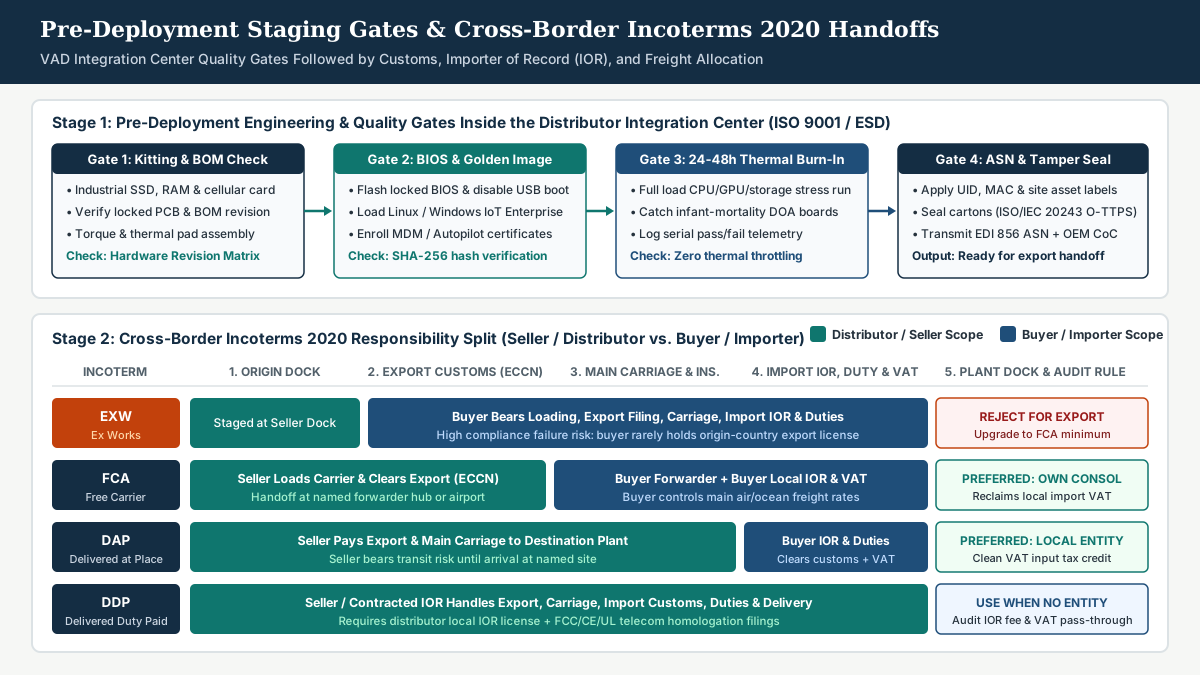
| Incoterms 2020 rule | Risk and cost transfer point | Customs, ECCN export, and Importer of Record (IOR) allocation | When to accept or reject in hardware contracts |
|---|---|---|---|
| EXW (Ex Works) Named Distributor Warehouse | Goods placed at the buyer’s disposal at the distributor’s loading dock, unloaded onto the collecting vehicle | Buyer must arrange both origin-country export customs clearance (including ECCN encryption filings) and destination import clearance (IOR) | Reject for cross-border IT procurement unless the buyer has a registered legal entity and licensed export broker in the distributor’s origin country; replace with FCA at minimum |
| FCA (Free Carrier) Named Terminal / Forwarder Hub | Distributor loads goods onto the buyer’s nominated carrier or delivers to the forwarder’s export consolidation hub | Distributor completes origin export customs declaration and ECCN filing; buyer handles main international carriage, cargo insurance, and destination import clearance (IOR) | Standard choice when the buyer operates a consolidated freight forwarder contract and holds a local subsidiary in the destination country to act as IOR and reclaim import VAT |
| DAP (Delivered at Place) Named Plant / Data Center | Distributor pays export and main carriage and bears transit risk until goods arrive at the buyer’s named site ready for unloading | Distributor clears export; buyer’s local entity acts as Importer of Record (IOR), files destination customs entry, and pays import duties and VAT directly to customs | Effective when the distributor manages door-to-door freight, while the buyer’s local entity clears customs directly so import VAT/GST remains recoverable on local tax returns |
| DDP (Delivered Duty Paid) Named Plant / Data Center | Distributor bears all freight, insurance, export/import customs clearance, duties, and delivery risk right to the buyer’s receiving dock | Distributor (or its contracted third-party IOR partner) acts as Importer of Record, files local telecom/safety homologation (FCC, CE, UL), and pays all tariffs and import taxes | Use when deploying hardware into countries where the buyer has no local legal entity or import license; verify upfront that the distributor holds valid local IOR authority and itemizes non-recoverable VAT |
Evaluating distributor credit terms and early-payment discount APR
On the ITA Methods of Payment guide, international trade payments span five mechanisms from highest buyer cash exposure to highest seller credit exposure: Cash in Advance, Letters of Credit (LC), Documentary Collections, Open Account (typically Net-30, Net-60, or Net-90 days), and Consignment. In the hardware distribution channel, creditworthy buyers and VARs negotiate either Net-30 to Net-60 open account lines, vendor-subsidized channel flooring facilities (where a finance provider such as DLL or CDF pays the distributor immediately and gives the buyer 60 days of interest-free flooring), or early-payment cash discounts such as 2/10 Net 45.
To decide whether to take an early-payment discount or hold cash until the full net due date, compare the implied annualized financing rate of foregoing the discount against the buyer’s revolving credit line or channel flooring rate:
APR_discount = (d / (1 - d)) * (365 / (N_net - N_disc))In this equation:
dis the early-payment discount percentage expressed as a decimal.N_netis the full invoice due date in calendar days.N_discis the early-payment discount deadline in calendar days.APR_discountis the implied simple annualized interest rate paid for holding cash over the extraN_net - N_discdays.
Worked example: In a conditional calculation example where an IT hardware distributor offers 2/10 Net 45 payment terms (d = 0.02 discount if paid within N_disc = 10 days, otherwise full invoice price due at N_net = 45 days), foregoing the 2% discount to delay payment by 45 - 10 = 35 days carries an implied annualized financing cost of:
APR_discount = (0.02 / (1 - 0.02)) * (365 / (45 - 10))
APR_discount = 0.020408 * 10.4286 = 0.2128 (21.28% APR)
If the buyer’s corporate revolver or channel flooring line carries an interest cost of 8% to 10% APR, paying the distributor on Day 10 to capture the 2% discount (or routing the purchase through a 60-day vendor-subsidized 0% flooring facility) reduces total procurement expense compared with stretching the open account to Day 45. As explained in the manufacturing cost formula behind unit economics, financing and interest charges sit outside GAAP factory unit cost as period expenses, yet the selling price or project budget must still recover them.
Rule of thumb: Never accept EXW on a cross-border hardware purchase order, and always take an early-payment discount when its implied APR_discount exceeds your short-term borrowing cost by more than 300 basis points.
Takeaway: Pair FCA or DAP with your own local subsidiary IOR to preserve import VAT recovery, reserve DDP for entity-free foreign sites where the distributor provides a licensed IOR, and benchmark cash discounts against channel flooring APR.
Weighted RFQ evaluation scorecard for IT and industrial hardware distributors
Before awarding an annual supply agreement or a multi-site project blanket purchase order, procurement and operations teams can score competing Tier-1 distributors and specialty VADs against a 100-point weighted evaluation matrix. Any bidder that fails a mandatory pass/fail gate is disqualified before commercial price weighting is applied.
| Audit category | Weight (points) | Mandatory pass/fail qualification gate | Full-score target benchmark (100% of category weight) |
|---|---|---|---|
| 1. OEM Franchise & ISO/IEC 20243 Traceability | 25 | Must appear on the OEM’s official Partner Locator for the delivery region and provide a valid LOA + Certificate of Conformance | Direct Tier-1 OEM franchise with automated SPA / Deal Registration binding, O-TTPS (ISO/IEC 20243) certification, and pre-shipment EDI 856 serial/MAC ASN |
| 2. RMA Turnaround & Local FRU Spares Pool | 25 | Must commit in writing to a 30-day DOA advance replacement window and a defined regional depot repair TAT | 24 to 48 hour DOA cross-shipment, 5 to 10 business day regional depot bench TAT, and a serialized, ring-fenced 2% to 5% local FRU hot-swap pool |
| 3. Embedded BOM Lock & LTB Continuity | 15 | For industrial/embedded SKUs, must enforce fixed BOM revision control and pass through OEM PCN/EOL alerts | 5 to 15 year roadmap tracking, locked Hardware Revision Matrix (PCB, BIOS, SSD die), 90 to 180 day PCN gate, and 6 to 12 month LTB + bonded LTS storage |
| 4. Pre-Deployment Staging & Burn-In | 15 | Integration facility must maintain ESD controls and verify pre-loaded OS/BIOS image hashes | ISO 9001 integration center executing custom kitting, SHA-256 verified golden OS imaging, 24 to 48 hour thermal chamber burn-in, and physical UID asset tagging |
| 5. Cross-Border Incoterms 2020 & IOR Capability | 10 | Must support FCA/DAP export ECCN filings or verified local IOR capability when quoting DDP | Multi-country hubs offering bonded blanket PO storage, clean ECCN encryption clearance, and transparent DDP Importer of Record fee and VAT itemization |
| 6. Net Credit & Channel Flooring Terms | 10 | Must offer open account or channel flooring without requiring unbonded wire prepayment on production orders | Net-45 to Net-60 open account credit limit sized to peak rollout months, 60-day vendor-subsidized channel flooring, or >= 2% early-payment discount |
When contracting with the winning distributor, incorporate the ITA foreign representative agreement safeguards: limit any initial appointment or preferred-supplier exclusivity to a 1-year term renewable upon meeting objective SLA and volume KPIs, specify 30, 60, or 90-day written termination notice windows, require scheduled quarterly reconciliation of the ring-fenced FRU spare-parts serial list, and stipulate the return of custom OS images, security certificates, and asset registries upon contract exit.
Takeaway: Disqualify any bidder that lacks verifiable OEM franchise status or serial-level ASN traceability before scoring price; use the 100-point matrix to bind RMA spares, BOM locks, staging burn-in, and Incoterms 2020 into the master supply agreement.