
A small manufacturer builds international sales channels by deciding, market by market, who will find buyers, own the goods, collect payment and support the product, then choosing direct sales, agents, distributors, export intermediaries, online selling or a partnership to match. Get that allocation wrong and essential work falls between factory and partner: no one holds spare parts, a distributor wants credit the factory cannot finance, or an exclusive territory goes to a firm that cannot cover it.
Country-specific law and individual platforms are not covered.
| Item | What it means | Source or condition |
|---|---|---|
| Direct sale | Manufacturer sells to the foreign customer and runs the export | US guidance; heavy management time |
| Commission agent | Arranges sales for commission; holds no stock | UK guidance, typical model |
| Distributor | Buys, stocks and resells locally; often services | UK and Canadian guidance; confirm in the agreement |
| Export intermediary | Domestic firm that finds buyers, ships and collects payment | US and Canadian guidance; buys outright or works on commission |
| Supplying an exporter | Parts reach foreign markets inside another firm’s exports | OECD (2019); not your own overseas customer |
What changes from one channel to the next
The routes differ in who signs the sale with the end customer, who owns and stores the goods, and who supports the customer afterwards.
Direct sales. The manufacturer deals with the foreign buyer and handles the export, which the US International Trade Administration (ITA) says takes a significant commitment of management time.
Commission agents. In UK Department for Business and Trade guidance, an agent sells on the manufacturer’s behalf for commission and holds none of its stock; the sale is between manufacturer and end user, and the manufacturer usually handles fulfilment and after-sales service. Canada’s Trade Commissioner Service (TCS) says agents can be authorised to sign sales contracts.
Distributors. A distributor buys the goods, usually in bulk at a discount, resells them, typically holds local stock and often provides after-sales service. UK guidance notes it may expect big discounts and credit terms, and the manufacturer loses direct contact with end customers.
Export intermediaries. Export management and trading companies are domestic firms that, ITA says, take responsibility for finding overseas buyers, shipping and getting paid. TCS notes that some buy products outright while others act as agents, selling on commission, which changes who owns the goods.
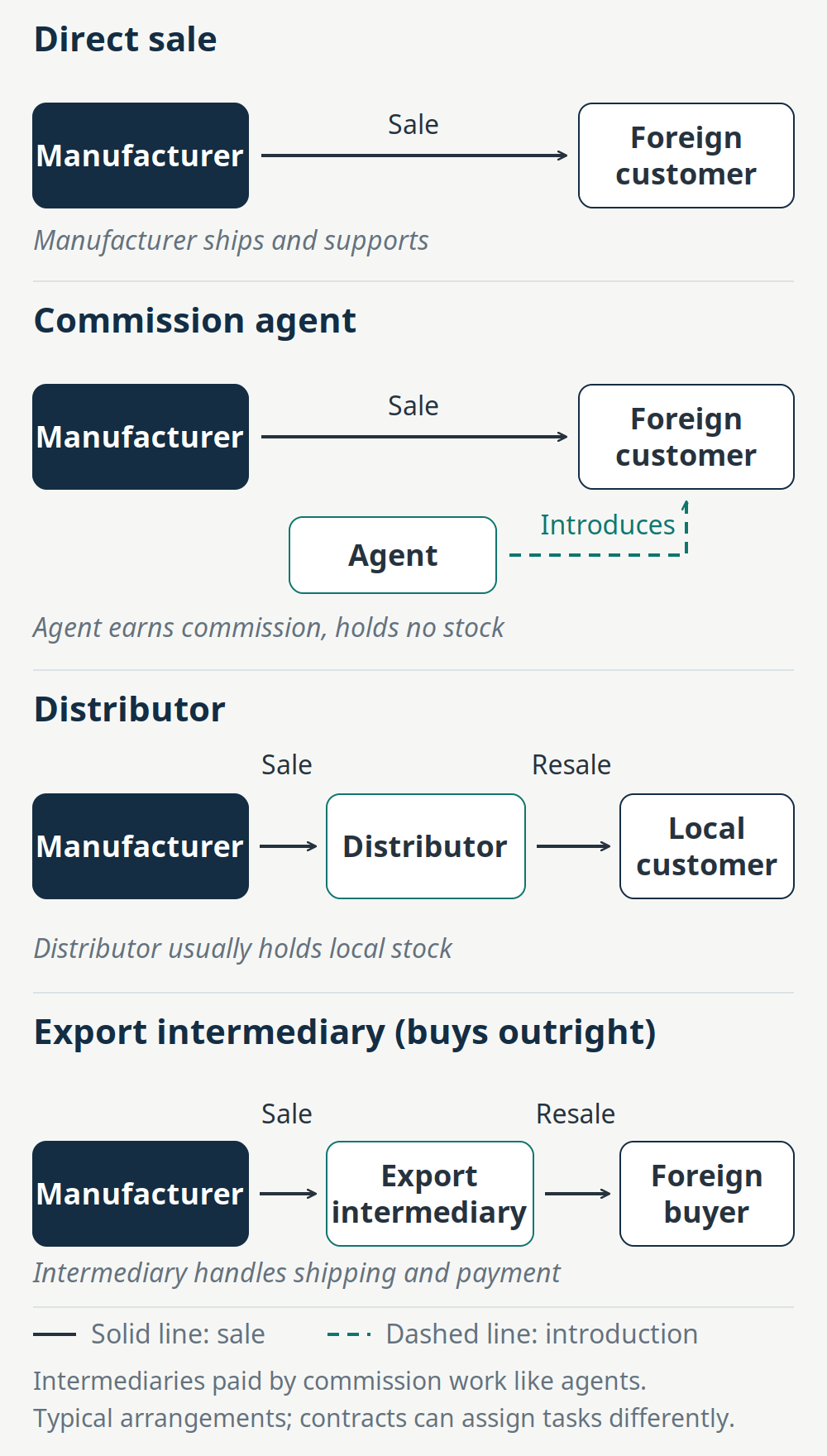
Common mistake: Assuming a commission agent will hold stock, install equipment or carry spare parts unless the contract assigns and pays for those tasks.
Takeaway: Before comparing channels, write down who sells, who owns the stock and who services the product under each option.
Direct vs indirect exporting, entry modes and supply chains
Three frameworks describe exporting at different levels.
Sales channel. ITA calls it direct selling when the producer handles the export and deals with the buyer; agents, distributors, wholesalers, export intermediaries and eCommerce platforms count as indirect. TCS likewise treats selling to a foreign distributor, or through a foreign agent who does not buy the goods, as indirect.
Market-entry mode. TCS also sorts market entry into four broader categories: direct exports, indirect exports, partnerships, and acquisitions or investments. In TCS guidance, partnerships such as licensing or joint ventures suit gaps in expertise or local presence; licensing may involve no export of the manufacturer’s goods.
Supply-chain participation. The OECD SME and Entrepreneurship Outlook 2019 found that, in OECD countries, counting only small firms’ direct exports understates their engagement, because many supply inputs to larger exporters. In its Slovak Republic example (2014 data), SMEs accounted for 34% of gross exports but 56% of the total value added in exports. A component maker’s domestic customer that exports may already carry its goods abroad.
Takeaway: Match each label to its question: who sells to the buyer, which entry strategy, or which exports already go through customers.
Choosing a route by the capability you lack
Start from the work the firm cannot do in that market; several routes can run at once. ITA’s factors include resources, risk tolerance, the product and market conditions; TCS adds financial capacity and the after-sales support customers need.
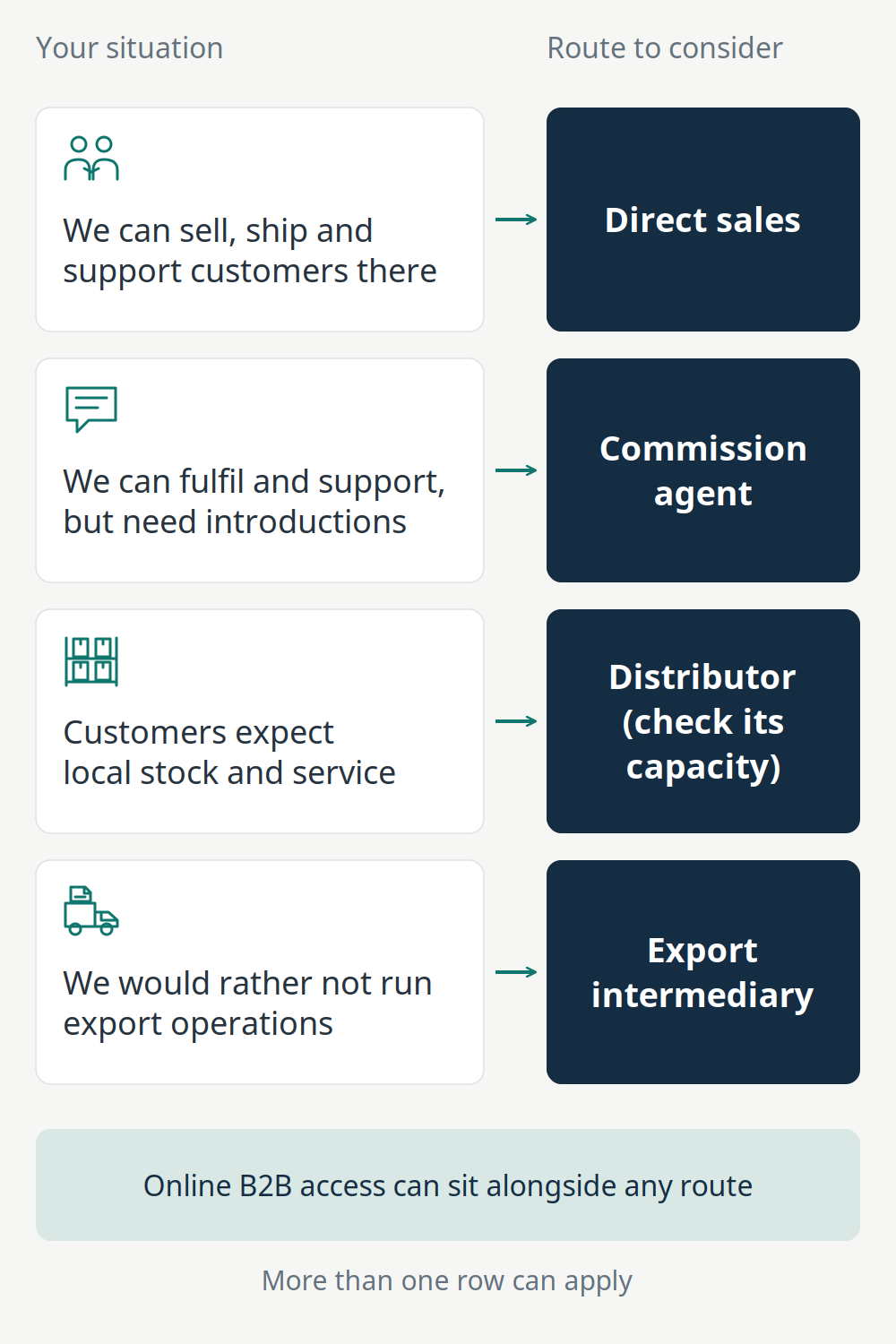
A firm that can fulfil and support but needs introductions may suit an agent; one whose customers expect local stock and service should assess distributors on actual capacity. TCS suggests an intermediary may be the best way in for many new exporters, tested through a short-term trial contract.
Online access sits across these routes; ITA notes that some eCommerce platforms store and deliver abroad for fees, while others leave shipping to the seller. Delivery reliability matters on every route; what digital manufacturing changes on the factory floor covers production.
Common mistake: Treating an online listing as a complete channel. Payment, delivery and after-sales still need an owner.
Takeaway: Choose the routes that fill your specific gaps, and expect to run more than one.
How to find foreign distributors and agents
UK guidance points to sites listing agents and distributors by sector and country and to trade associations in the target market, and advises searching in the local language as well as English. Government partner-search services, such as the US Commercial Service, identify and vet prospects and arrange meetings, subject to their own eligibility and fees. Trade shows and freight forwarders also supply leads. TCS recommends talking to several firms and doing due diligence before a limited-term trial.
Takeaway: Treat every name as a lead to be checked, not as a partner.
What to check before appointing a partner
ITA’s checklist for choosing a foreign representative says key factors vary with product and country. For a manufacturer, start here:
| Area | What to ask | Why it matters |
|---|---|---|
| Territory | Which regions does it cover, and where are its offices? | Coverage should match where buyers are |
| Product lines | Do any of its lines compete with yours? | A rival line may get priority |
| Customers | What kinds of customers does it call on? | Shows whether it reaches your buyers |
| Service | If the product needs servicing, is it equipped and qualified, or willing to train? | Customers expect support where they buy |
| Spare parts | Where necessary and customary, will it stock repair parts? | Otherwise parts must come from the factory |
Common mistake: Granting exclusivity at the first meeting; ITA advises waiting until the representative has proven itself, or limiting it to a defined period.
Takeaway: Ask for evidence that applies to your product and territory, not a general company profile.
What the agreement and the factory still have to cover
ITA’s agreement topics include territory and exclusivity, performance requirements, whether the representative is a legal agent with power of attorney, and termination terms such as notice, governing law and compensation. In return, ITA advises giving representatives pricing, payment terms, product regulation information, training and a realistic view of delivery capability.
Payment terms set the factory’s credit risk. In ITA’s payment guidance, cash in advance avoids credit risk but is least attractive to buyers; open account, paid after delivery, is one of the riskiest options for the exporter; consignment, paid only after the distributor resells, is very risky.
In direct and agent arrangements, shipping usually stays with the factory; why port and logistics infrastructure matters to smaller exporters explains what happens after the sale.
Takeaway: Agree in writing what the partner does, and name someone in the factory to supply what the partner needs.
Where this does not hold
This approach weakens when:
- Volumes are low. Distributors need enough business to justify a line, as ITA’s checklist notes.
- The product is service-heavy. A sales agent alone does not solve installation and spare parts. The agent route still works if the manufacturer provides that support itself or contracts a partner equipped for it.
- Margins or cash are thin. Distributor discounts, credit terms and consignment tie up margin and working capital.
- Local law decides. Agency, exclusivity and termination rules vary by country.
More on how firms reach markets is in Business.
Takeaway: If volume, margin or service capacity is missing, address that gap before adding channels.
How we researched this
We used US, UK and Canadian government export guidance, read in October 2026, and the OECD’s 2019 SME and Entrepreneurship Outlook, whose figures are historical. We found no reliable data comparing channel profitability. See our editorial policy and About page.
Takeaway: This article compares options from official guidance rather than ranking channels by performance.