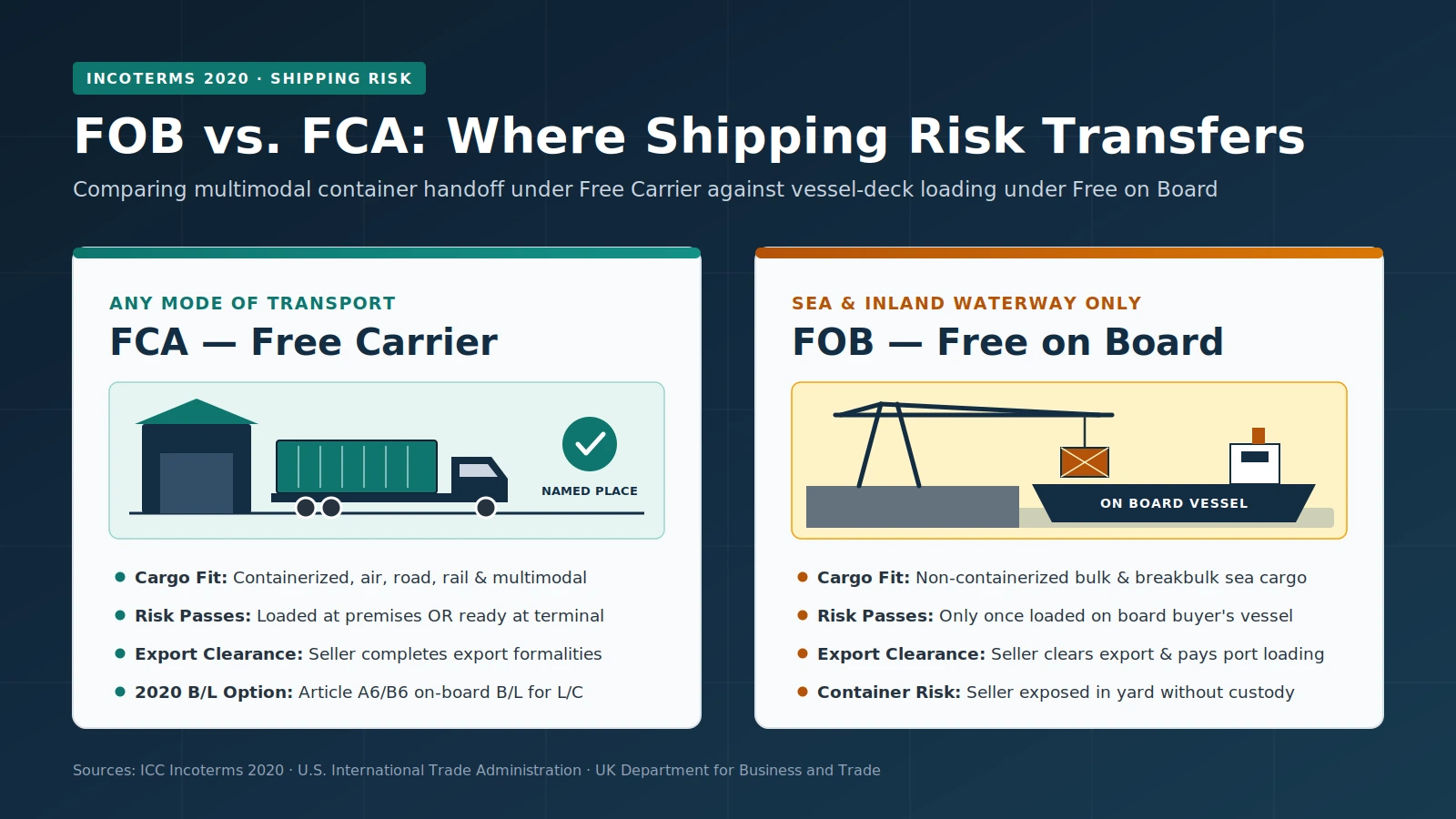
FOB vs FCA comes down to transport mode and where shipping risk transfers under Incoterms 2020. Free Carrier (FCA) covers any mode—including containerized cargo—and shifts risk at a named place such as a factory dock or terminal, whereas Free on Board (FOB) applies only to non-containerized sea freight loaded on board the vessel.
Both rules belong to the global contract standard published by the International Chamber of Commerce (ICC) and are recorded on sales contracts and export invoices across global trade and logistics networks. Choosing between fca vs fob aligns who controls physical custody of the cargo with who bears the risk of damage or loss before the main voyage begins.
| Comparison Dimension | FCA (Free Carrier) | FOB (Free on Board) |
|---|---|---|
| Eligible transport modes | Any mode of transport, including containerized sea, air, road, rail, and multimodal carriage | Non-containerized sea and inland waterway freight only |
| Named geographic point | Named place of delivery (seller’s premises, inland depot, or port terminal) | Named port of loading designated for the buyer’s vessel |
| Delivery and risk transfer point | Loaded onto buyer’s carrier at seller’s premises, or arriving ready to unload at another named place | Loaded on board the buyer-designated vessel and appropriated to the contract |
| Origin terminal unloading | Buyer unloads seller’s transport when delivery is at an off-site terminal | Seller pays inland delivery, port handling, and vessel loading onto ship |
| Letter of Credit on-board B/L | Optional under Incoterms 2020 article A6/B6 via buyer instruction to carrier | Standard ocean bill of lading tied directly to on-board loading |
| Main carriage and marine insurance | Arranged and paid by buyer from the named delivery point | Arranged and paid by buyer after cargo is placed on board the ship |
What Do FOB and FCA Mean Under Incoterms 2020?
Under Incoterms 2020, FOB stands for Free on Board and FCA stands for Free Carrier, two of 11 standardized three-letter trade terms published by the International Chamber of Commerce (ICC). Each rule specifies cargo delivery tasks, allocates costs, and establishes the exact point where risk of loss or damage passes from seller to buyer.
Used globally in trade contracts since 1936 and updated in 2020, the Incoterms framework provides uniform interpretation of recurring international sales clauses, as summarized by the U.S. International Trade Administration and European Commission Access2Markets. Within each rule, Delivery carries a formal legal meaning: it marks the point in the transaction where the risk of loss or damage to the goods passes from the seller to the buyer.
The UK Department for Business and Trade notes that exporters should record the agreed rule on export invoices alongside the underlying sales agreement. Parties may still agree to apply Incoterms 2010 or an earlier edition after January 1, 2020, provided the chosen edition is named clearly on the sales contract and export documents.
How Do Transport Modes and Risk Transfer Differ Between FOB and FCA?
Transport mode is the primary divider in fob vs fca: Incoterms 2020 places FCA among the seven rules for any mode of transport, while restricting FOB to the four rules for sea and inland waterway transport. Risk shifts to the buyer at the named place under FCA, but only once cargo sits on board the vessel under FOB.
The seven any-mode rules in Incoterms 2020 are EXW (Ex Works), FCA (Free Carrier), CPT (Carriage Paid to), CIP (Carriage and Insurance Paid To), DAP (Delivered at Place), DPU (Delivered at Place Unloaded), and DDP (Delivered Duty Paid). The four maritime-only rules are FAS (Free Alongside Ship), FOB (Free on Board), CFR (Cost and Freight), and CIF (Cost Insurance and Freight).
Why FOB Creates a Container Yard Risk Blind Spot
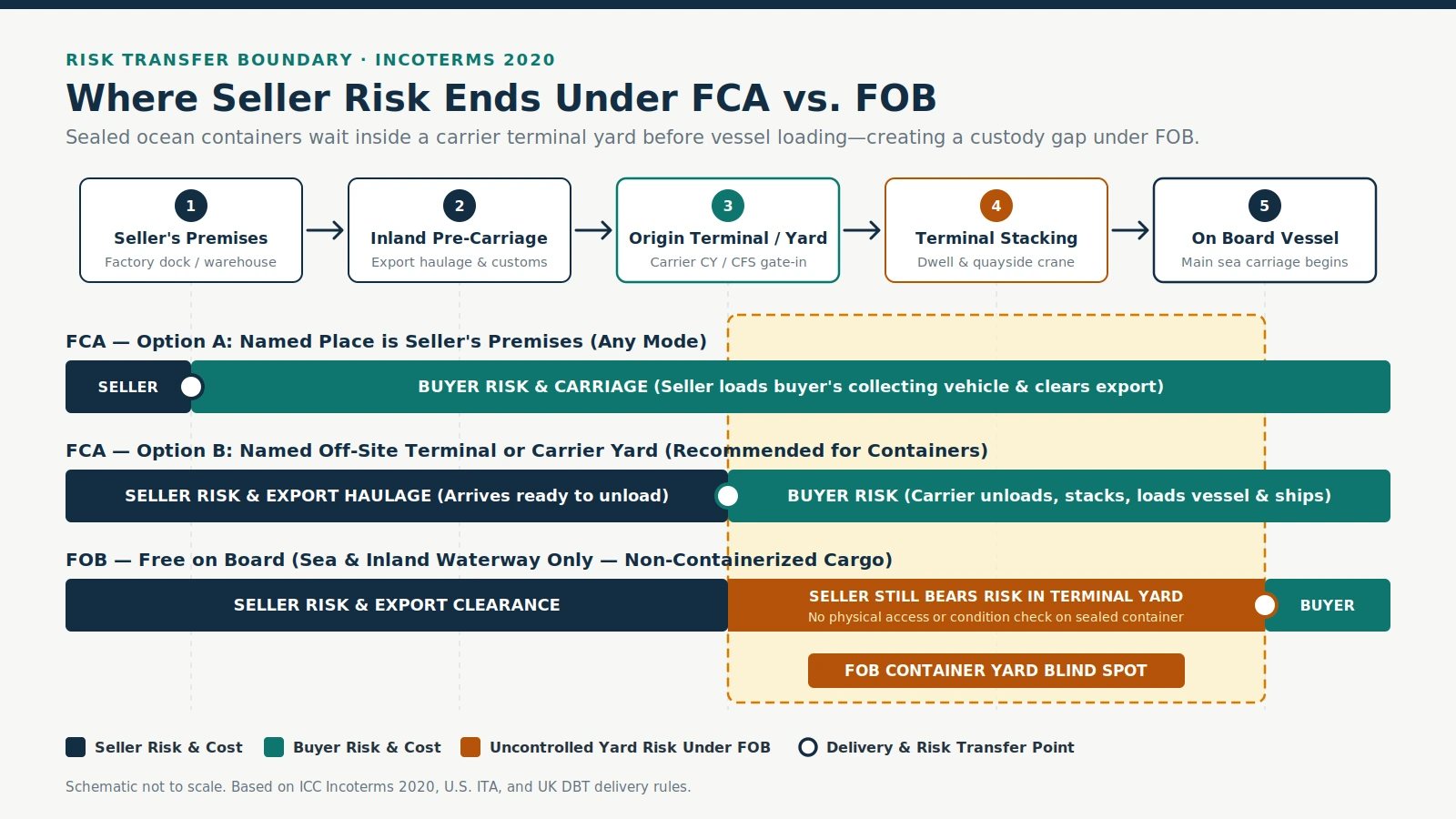
The four sea and inland waterway rules are built for water transport where cargo condition can be inspected as goods are loaded on board the vessel. They are unsuitable for sealed shipping containers, combined multimodal shipments, road, air, or rail freight, because once goods are locked inside a container it is impossible to verify internal condition at vessel loading.
In practice, containerized exports move into a port container yard or inland freight terminal ahead of the ship’s sailing schedule, a waiting interval examined alongside terminal dwell clocks in our explainer on port and logistics infrastructure for smaller exporters. Under fca incoterms, the seller hands the export-cleared container to the buyer’s carrier at that named terminal and transfers risk immediately; under FOB, the seller retains risk across the yard stack even after surrendering physical control to the buyer’s carrier.
When Free on Board Still Fits Sea and Inland Waterway Cargo
FOB remains appropriate for non-containerized ocean or inland waterway commodities—such as breakbulk machinery crates or bulk freight—hoisted directly onto a buyer-designated vessel at the named port of loading. In earlier Incoterms editions, FOB risk passed at the ship’s rail, whereas Incoterms 2020 places the transfer point once the goods are loaded on board the vessel and clearly appropriated to the sales contract.
Under FOB, the exporter maintains control over domestic transport and export customs clearance up to vessel loading, but loses operational control over handling and sea carriage the moment loading completes. Since Incoterms 1980 introduced FCA, modern containerized trade has shifted away from FOB toward FCA whenever goods enter a terminal rather than moving straight onto a ship’s deck.
Why Does FCA Seller’s Premises Differ From an Off-Site Terminal Handoff?
Under fca incoterms, naming the seller’s factory versus naming an off-site port terminal reverses who handles loading and unloading at delivery. At the seller’s premises, the seller must load the goods onto the buyer’s collecting vehicle before risk transfers; at any other named place, the seller delivers on its arriving truck ready for unloading.
This two-location design is what makes FCA flexible across factory pickups, inland rail depots, airport cargo sheds, and seaport container yards. Within Incoterms definitions, a Terminal means any covered or uncovered facility such as a dock, warehouse, container yard, or road, rail, or air cargo terminal.
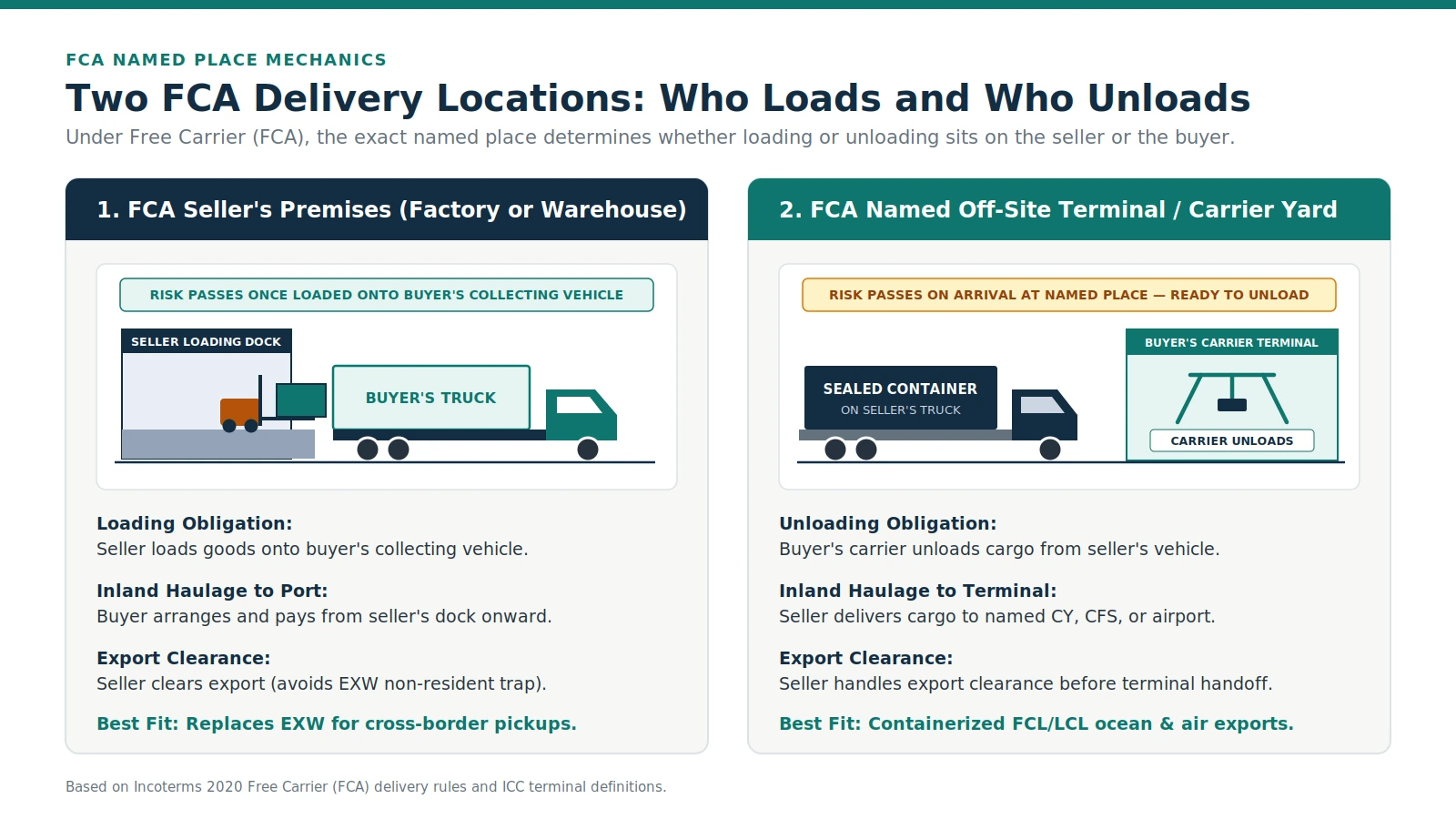
Because the named place governs both physical labor and liability during transfer, contracts should write out the exact facility address rather than a broad city name:
| Delivery Detail | FCA Seller’s Premises | FCA Named Off-Site Terminal |
|---|---|---|
| Physical handover point | Seller’s factory, warehouse, or another site under seller control | Carrier container yard, freight station, rail hub, or airport |
| Vehicle loading at origin | Seller loads goods onto buyer’s collecting transport | Seller loads its own truck to haul cargo to the named terminal |
| Unloading at named place | Not applicable at seller’s dock; buyer takes over once loaded | Buyer’s nominated carrier unloads goods from seller’s arriving vehicle |
| Domestic pre-carriage haulage | Buyer contracts and pays haulage from seller’s dock to port | Seller arranges and pays haulage to the named off-site terminal |
| Export customs formalities | Completed and paid by seller prior to handover | Completed and paid by seller prior to terminal delivery |
Incoterms 2020 also recognizes that commercial shipments are not always moved by a third-party carrier, allowing the buyer (under FCA) or seller (where pre-carriage applies) to use their own means of transport rather than hiring an outside carrier.
Who Pays Export Clearance, Terminal Handling, and Main Carriage?
Under both FCA and FOB, the seller pays overseas transport packing and export customs clearance, while the buyer contracts and pays main ocean or air carriage, cargo insurance, destination unloading, and import clearance. The cost divergence sits in origin pre-carriage, terminal unloading, and vessel loading, which fall on the seller under FOB.
In Incoterms 2020, every cost obligation for a given rule is consolidated inside article A9/B9 while also remaining in its individual operational articles so contract teams can review expected charges in one place. The latest edition likewise details security-related requirements in article A4 on carriage and article A7 on export and import clearance, with those compliance costs summarized in article A9/B9.
| Shipment Stage | FCA Seller’s Premises | FCA Named Terminal | FOB Named Port |
|---|---|---|---|
| Overseas export packing and pre-shipment inspection | Seller packs and covers required export checks | Seller packs for carriage to terminal and export | Seller packs for port handling and vessel stowage |
| Export licenses and customs clearance | Seller clears export formalities | Seller clears export before carrier handoff | Seller clears export prior to ship loading |
| Inland haulage to origin terminal or port | Buyer arranges and pays from seller’s facility | Seller delivers goods to named terminal gate | Seller transports cargo to named loading port |
| Unloading truck at origin port or terminal | Buyer’s forwarder handles port reception | Buyer’s carrier unloads seller’s arriving truck | Seller covers terminal unloading and reception |
| Loading goods on board export vessel | Buyer pays terminal lift onto ship | Buyer pays vessel loading charges | Seller pays loading on board buyer’s ship |
| Main international carriage and bill of lading fees | Buyer contracts carrier and pays freight | Buyer contracts main carrier and freight fees | Buyer pays marine freight and B/L fees |
| Cargo transit insurance | Neither party obligated by rule; buyer bears transit risk | Neither party obligated by rule; buyer bears yard and ocean risk | Neither party obligated by rule; buyer bears sea voyage risk |
| Destination unloading and import clearance | Buyer clears import and pays duties | Buyer clears destination port and import duties | Buyer unloads at arrival port and clears import |
For buyers building a full doorstep budget from an origin quote, our breakdown of total cost of importing industrial equipment maps how origin freight, destination charges, and customs lines stack after the Incoterm handoff.
How Does FCA Article A6/B6 Solve the On-Board Bill of Lading Problem?
Incoterms 2020 revised FCA article A6/B6 so buyer and seller can agree that the buyer instructs its ocean carrier to issue an on-board bill of lading to the seller once goods are loaded on board the vessel. That option eliminates the historical trade-finance pressure that pushed container exporters into misusing FOB for Letters of Credit.
As outlined in U.S. International Trade Administration guidance on Letters of Credit, a Letter of Credit commits the foreign buyer’s bank to pay only once the exporter ships the goods and presents strictly complying documents to the exporter’s bank. Under U.S. ITA export document guidance, ocean trade relies on straight (non-negotiable) or shipper’s order (negotiable) bills of lading, and the buyer usually needs an original bill of lading as proof of ownership to claim cargo from the ocean carrier—unlike air freight, which uses non-negotiable air waybills.
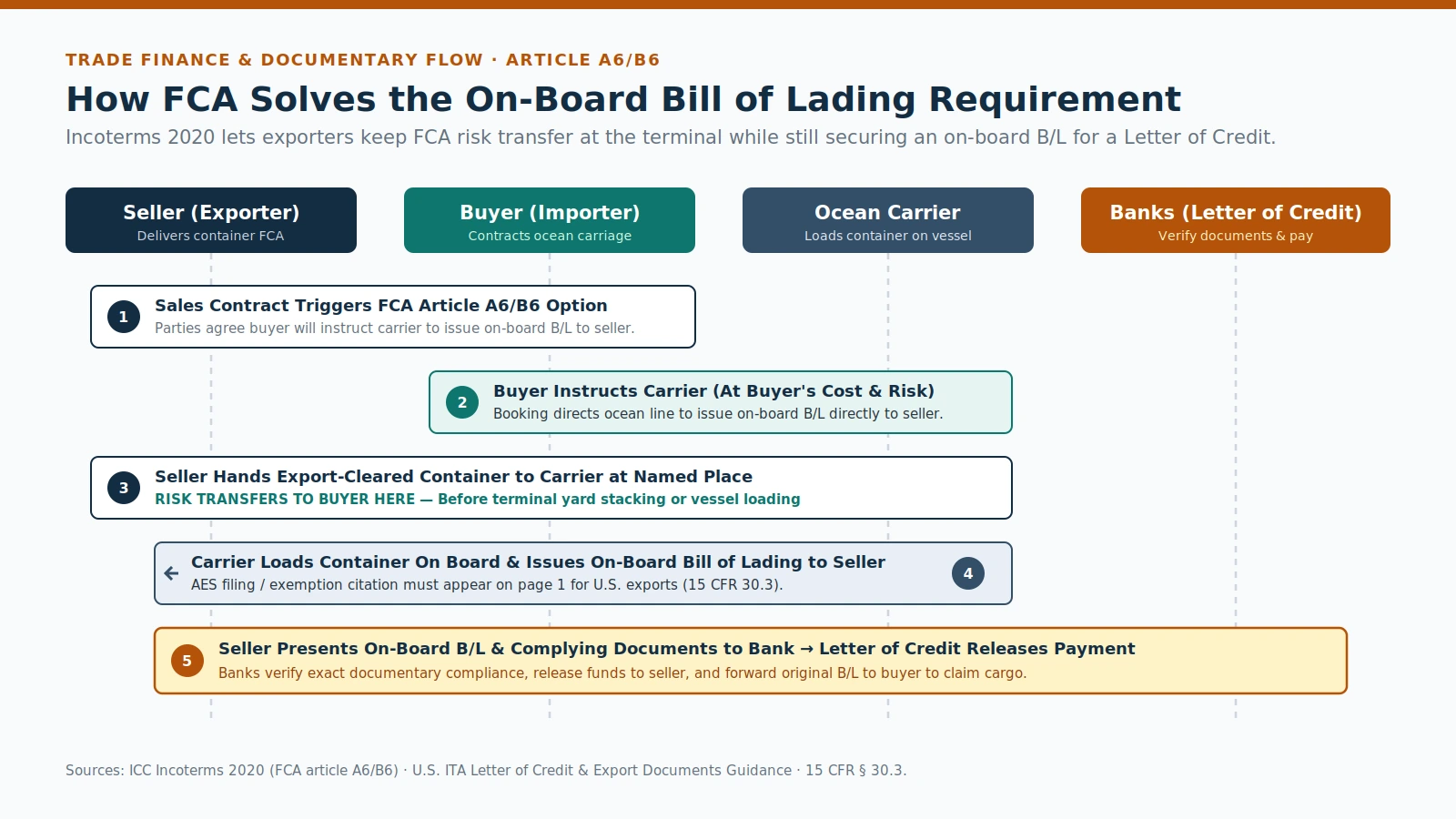
Before Incoterms 2020, exporters shipping containers under FCA faced a documentary deadlock: risk passed at the terminal before loading, yet banks refused payment without an on-board notation proving vessel loading. Because Letter of Credit documents are detailed and prone to discrepancies that delay payment and trigger extra bank fees, U.S. ITA shipping guidance advises relying on trained professionals—such as freight forwarders licensed by the International Air Transport Association (IATA) for air freight and the Federal Maritime Commission for ocean freight—to verify document compliance alongside the FCA article A6/B6 clause.
How Do FOB and FCA Compare With EXW and CIF?
Comparing fca vs fob alongside EXW and CIF highlights where seller obligations begin and end: EXW stops before loading or export clearance, FCA ends at carrier handover with export cleared, FOB extends to vessel loading, and CIF adds seller-paid main sea freight and minimum cargo insurance to the destination port.
| Trade Term | Transport Mode Scope | Export Clearance | Risk Transfer Point | Main Carriage and Insurance |
|---|---|---|---|---|
| EXW (Ex Works) | Any transport mode | Buyer handles export formalities | Goods placed at buyer’s disposal at seller’s premises | Buyer arranges all carriage and insurance |
| FCA (Free Carrier) | Any transport mode | Seller clears export | Loaded on buyer’s vehicle at premises, or ready to unload at terminal | Buyer contracts main carriage and any insurance |
| FOB (Free on Board) | Sea and inland waterway only | Seller clears export | Loaded on board buyer’s vessel at loading port | Buyer pays sea freight, B/L fees, and insurance |
| CIF (Cost, Insurance and Freight) | Sea and inland waterway only | Seller clears export | Loaded on board vessel at port of shipment | Seller pays sea freight and default Clause (C) insurance to destination port |
FCA Seller’s Premises vs. EXW Export Clearance Risks
Under EXW, the seller makes goods available at its warehouse without loading the collecting truck or filing export customs formalities; if the seller assists with loading, it does so at the buyer’s risk and cost. In customs territories such as the European Union, regulations require the export declarant to be resident within the jurisdiction, preventing an overseas buyer from clearing exports legally and exposing the seller to domestic sales tax if the buyer fails to return proof of export.
Switching from EXW to FCA Seller’s Premises resolves both hazards while keeping domestic haulage and main carriage on the buyer’s account. The seller loads the collecting truck at its own dock and controls the export declaration directly.
FOB and FCA vs. CIF Maritime Cost and Insurance Scope
Under CIF, which is also restricted to ocean freight, the seller pays freight and cargo insurance to the named destination port, with default minimum cover under Institute Cargo Clauses (C) in both Incoterms 2010 and Incoterms 2020 (unless the parties agree to higher cover), while the buyer still bears transit risk once loaded and pays destination unloading and import clearance. By contrast, CIP—the any-mode counterpart for insured multimodal freight—requires higher default cover compliant with Institute Cargo Clauses (A) or similar clauses under Incoterms 2020.
In some markets, local customs authorities assess import duties on a specific valuation benchmark—such as CIF value in India or FOB value in South Africa—leading trading partners to write FOB or CIF into contracts even for containerized cargo. When customs valuation rules encourage a maritime label, parties must clarify risk transfer explicitly; readers evaluating destination-side maritime versus multimodal delivery can also review our companion comparison of Incoterms DAP vs CIF for machinery shipments.
U.S. Foreign Trade Regulations and UCC § 2-319 Boundaries
Exporters shipping from the United States encounter two statutory traps when reading FOB or FCA loosely. First, under 15 CFR § 30.3 of the U.S. Foreign Trade Regulations (FTR), Incoterms carry no regulatory authority and do not classify an export as standard or routed.
A standard export transaction occurs when the U.S. Principal Party in Interest (USPPI) arranges physical export movement, whereas a routed export transaction occurs whenever the Foreign Principal Party in Interest (FPPI) authorizes a U.S. forwarding agent to facilitate export and file Electronic Export Information (EEI)—a common reality under FCA Seller’s Premises or EXW. Regardless of trade term, an exporting carrier must not load or move cargo unless required loading documents display the Automated Export System (AES) proof of filing, postdeparture, downtime, exclusion, or exemption citation on the first page of the bill of lading or air waybill.
Second, U.S. domestic commercial contracts frequently apply Uniform Commercial Code § 2-319, where domestic F.O.B. functions differently from ICC Incoterms FOB. Under UCC § 2-319(1), F.O.B. place of shipment requires the seller to put goods into carrier possession under Section 2-504, F.O.B. place of destination requires delivery to destination at seller expense and risk under Section 2-503, and F.O.B. vessel, car, or other vehicle requires loading on board—applicable to trucks and railcars as well as ships. Writing the explicit edition label such as FCA or FOB followed by the named place and Incoterms 2020 prevents cross-border contracts from being interpreted under domestic UCC rules.
What Do Incoterms 2020 Leave Outside the Shipping Clause?
Even a precisely written FCA or FOB clause leaves essential commercial terms outside its scope, including contract price, payment method and timing, legal transfer of title or ownership, destination customs document lists, and remedies for delayed or non-conforming goods. Parties must draft separate contract clauses to govern those obligations.
Before signing a purchase order or sales contract under fob vs fca, legal and logistics teams should verify six items that sit outside the three-letter Incoterm itself:
- Exact version and named place: State the edition explicitly—such as Incoterms 2020 or Incoterms 2010—alongside the exact terminal address for FCA or named loading port for FOB.
- Title and ownership transfer: Define when legal ownership passes in the sales contract, because Incoterms govern delivery risk rather than transfer of title.
- Payment terms and LC documents: Specify payment timing and, where a Letter of Credit demands an on-board ocean bill of lading under FCA, incorporate the article A6/B6 carrier instruction clause.
- Import customs documentation list: Confirm ahead of shipment which commercial invoices, packing lists, certificates of origin, or special documents the buyer’s customs authority requires.
- U.S. export filing authority: Where shipping from the United States with a buyer-nominated forwarder, align USPPI and FPPI written authorizations for EEI and AES filing under 15 CFR § 30.3.
- Non-conforming cargo and dispute resolution: Add explicit contract clauses covering inspection, delayed delivery liability, governing law, and arbitration or court jurisdiction.