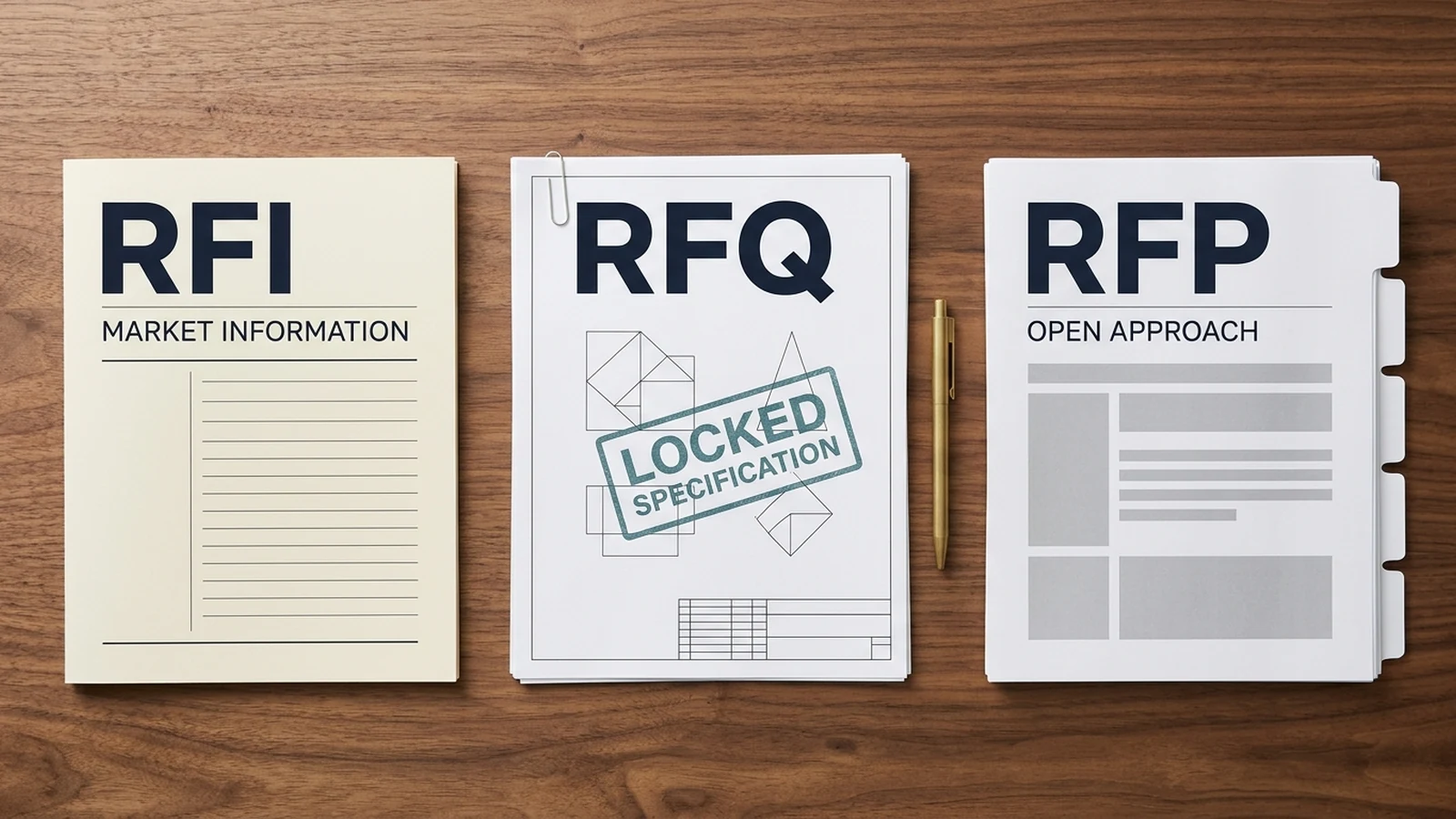
Under Federal Acquisition Regulation (FAR) 2.101, a response to a request for proposals (RFP) is a binding offer called a proposal, whereas a response to a request for quotations (RFQ) under simplified acquisition procedures is a quotation, not an offer. In a federal negotiated acquisition under FAR 15.101, cost or price may play a dominant role when the requirement is clearly definable and the risk of unsuccessful contract performance is minimal, while technical or past performance considerations may play a dominant role as the requirement grows less definitive, requires more development work, or carries greater performance risk.
Before either solicitation is issued, FAR 15.201(e) permits a request for information (RFI) when the government does not presently intend to award a contract and wants price, delivery, capabilities, or other market information for planning purposes. On the simplified-acquisition path, FAR 2.101 and FAR 13.004(a) define the government’s purchase order as the offer to buy, establishing a binding contract only when the supplier accepts that order. Companion explainers on commercial purchasing and supply contracts appear in our Business section.
| Federal procurement document | Controlling FAR or GSA source | Acquisition role and requirement stage | Legal status of supplier response | How a binding contract forms |
|---|---|---|---|---|
| Request for Information (RFI) | FAR 10.002 & FAR 15.201(e) | Market research and planning exchange when no contract award is presently intended | Informational response with no required format; not an offer | Cannot be accepted by the government to form a binding contract |
| Request for Quotations (RFQ) | FAR 2.101, FAR 13.004 & GSA SF 18 | Simplified acquisition solicitation stating whether award is on price alone or price and other factors | Quotation, not an offer; Standard Form 18 states that it is not an order | Government issues an order as its offer, and a contract forms when the supplier accepts |
| Request for Proposals (RFP) | FAR 2.101 & FAR 15.203(a) | Negotiated solicitation describing the requirement, terms, required proposal contents, and evaluation factors | Binding offer called a proposal | Government evaluates proposals and accepts the selected offer |
| Invitation for Bids (IFB) | FAR 2.101, FAR 6.401(a) & FAR 14.101 | Sealed bidding when discussions are unnecessary and award rests on price and price-related factors | Binding offer called a bid or sealed bid | Bids are publicly opened, evaluated without discussions, and awarded to the responsible conforming bidder |
| Purchase Order (PO) | FAR 2.101, FAR 13.004 & FAR 13.302-1 | Simplified-acquisition order specifying quantity or scope, a determinable date, and f.o.b. destination terms | Government’s offer to buy supplies or services, including construction and research and development | Supplier accepts by notice, preferably in writing, by furnishing the ordered supplies or services, or by substantial performance |
What Do RFI, RFQ, and RFP Stand For Across Procurement Regimes?
Under FAR 2.101, a solicitation is any request to submit offers or quotations to the federal government: solicitations under negotiated procedures are called requests for proposals, solicitations under sealed bid procedures are called invitations for bids, and solicitations under simplified acquisition procedures may require submission of either a quotation or an offer. Under that same FAR 2.101 definition, an offer is a response to a solicitation that, if accepted, would bind the offeror to perform the resulting contract, covering bids under sealed bidding and proposals under negotiation, while excluding simplified-acquisition quotations.
When a federal agency solicits written quotations rather than electronic or oral quotations, FAR 13.307(b)(1) permits using Standard Form 1449, GSA Standard Form 18 (Request for Quotations), or an agency form or automated format. Standard Form 18 (Rev. 6/1995) states “THIS IS NOT AN ORDER,” notes that it is a request for information and that quotations furnished are not offers, and specifies that the request does not commit the government to pay quotation preparation costs or to contract for supplies or service.
On its seller-facing guidance page Respond to a solicitation, the U.S. General Services Administration (GSA) notes that a contractor’s response to a contract opportunity is also referred to as an offer, a proposal, a quote, or a bid, advising respondents to address the contract requirements thoroughly. That GSA seller-page phrasing groups conversational response terms together, whereas FAR 2.101 separates binding offers (proposals and sealed bids) from non-binding quotations.
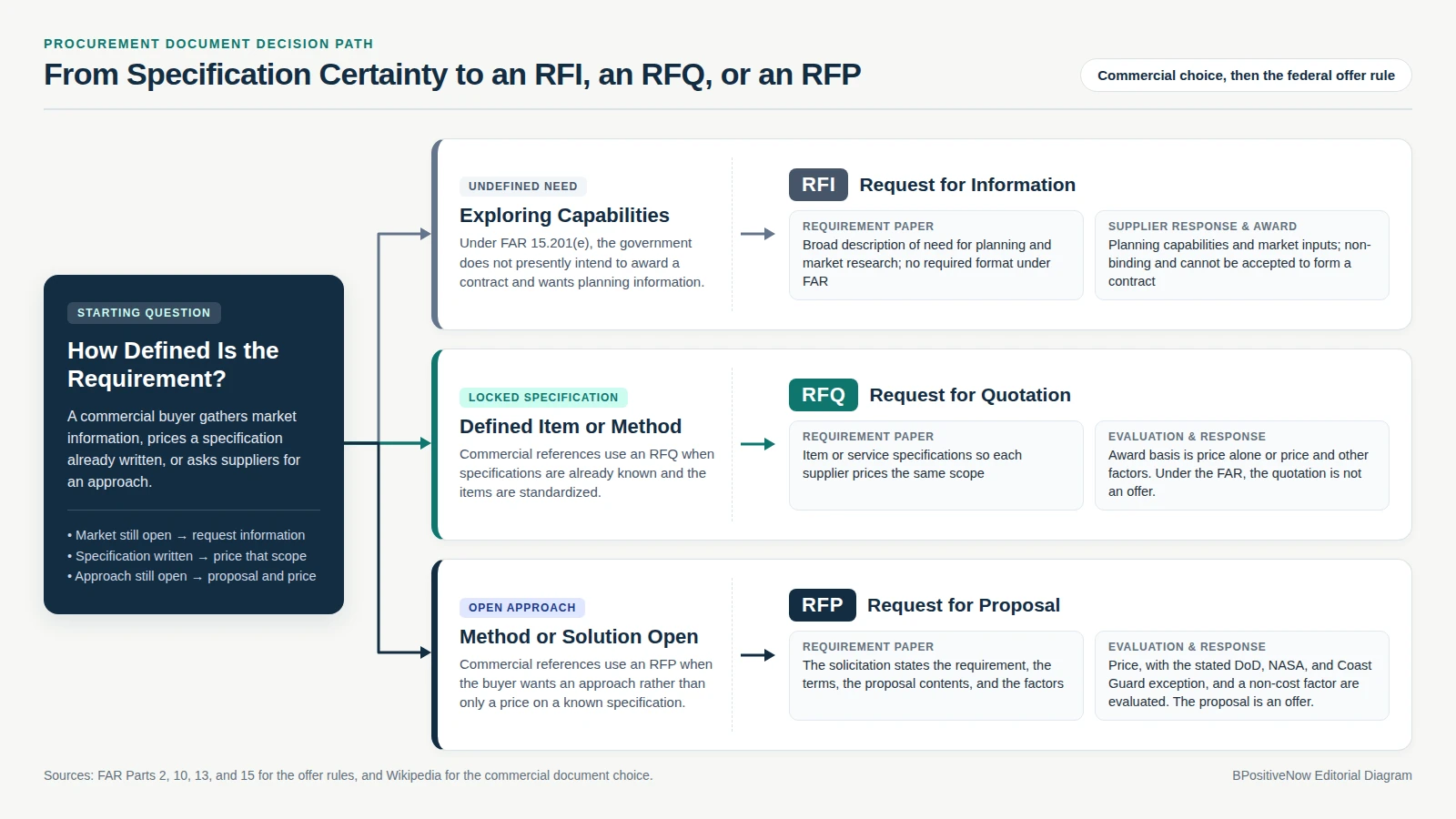
In commercial reference usage, Wikipedia’s Request for proposal article describes a pre-solicitation RFI as non-binding on both the buyer and the sellers, states that an RFI is not an invitation to bid, and notes that it may or may not lead to an RFP or an RFQ. In that same Wikipedia article, an RFQ is used when discussions with bidders are not required, mainly when product or service specifications are already known and price is the main or only factor in selecting a supplier, whereas an RFP gives suppliers more flexibility to propose an original service or product aligned with a company’s needs compared with invitations to tender.
When Should a Buyer Issue an RFI, an RFQ, or an RFP?
Under FAR 10.002(a), federal acquisitions begin with a description of the government’s needs stated in terms sufficient to allow market research, and one market-research technique listed in FAR 10.002 is publishing formal requests for information in appropriate technical or scientific journals or business publications. Under FAR 15.201(e), agencies may use an RFI when the government does not presently intend to award a contract and wants price, delivery, capabilities, or other market information for planning, with no required format and no binding contract formed from responses.
Once an agency is ready to solicit for a negotiated buy, FAR 15.101 links the selection approach directly to requirement certainty: cost or price may play a dominant role where the requirement is clearly definable and the risk of unsuccessful contract performance is minimal, whereas technical or past performance considerations may play a dominant role where the requirement is less definitive, more development work is required, or performance risk is greater.
GSA’s seller guidance page aligns three federal requirement documents with how completely the buyer can specify the work:
- Statement of Work (SOW): GSA states that the government uses an SOW when it knows exact work requirements and how the work needs to be done, asking the offer to show how all work will be delivered on time and as expected.
- Performance Work Statement (PWS): GSA states that the government uses a PWS when it knows the specific outcomes it needs and how it will measure those outcomes, while leaving it to the offeror to determine how to achieve them.
- Statement of Objectives (SOO): GSA states that the government uses an SOO when it is open to a wide range of solutions, requiring the offeror to develop and include a proposed PWS, performance metrics, a measurement plan, and a quality assurance plan.
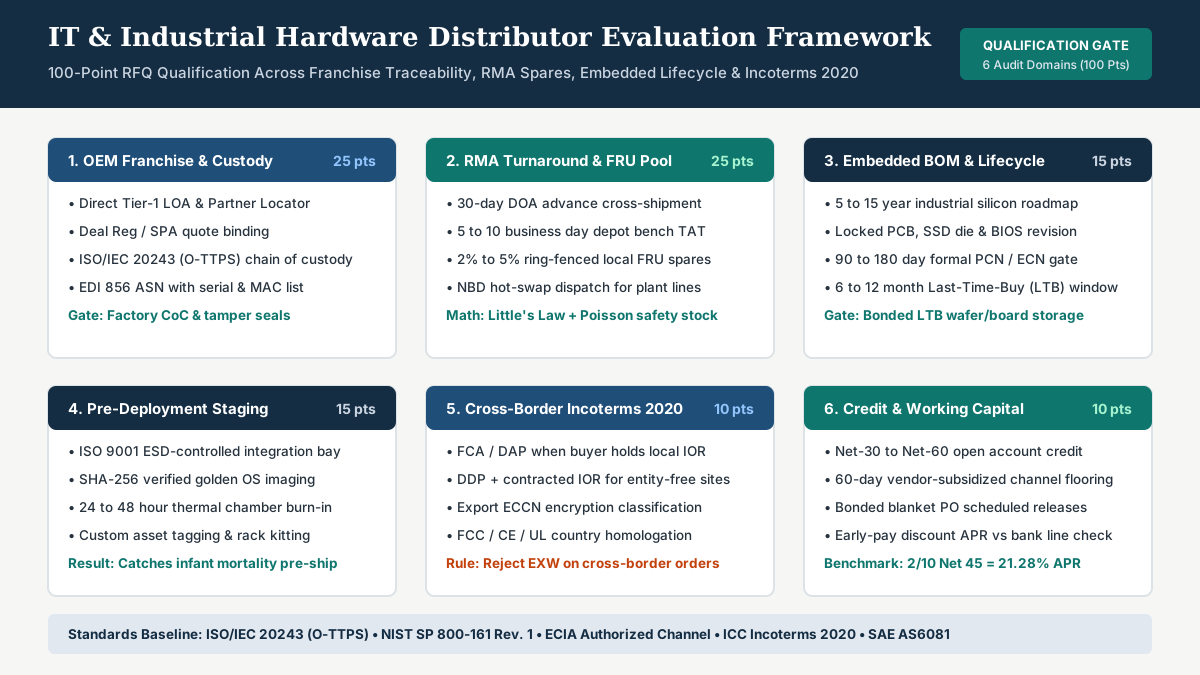
In commercial business practice, Wikipedia’s Request for quotation article states that an RFQ often includes item or service specifications so suppliers price the same scope, noting that more detailed specifications produce more accurate and comparable quotes. That Wikipedia entry adds that RFQs are best suited to standardized and commoditized products and services, and observes that in practice many businesses use an RFQ where a request for tender or an RFI would be more appropriate. When hardware specifications are already locked and the buyer’s next task is auditing OEM franchise authorization, serial traceability, and RMA spare pools, see our IT hardware distributor evaluation checklist.
How Do RFQ, RFP, and Purchase Orders Form a Contract?
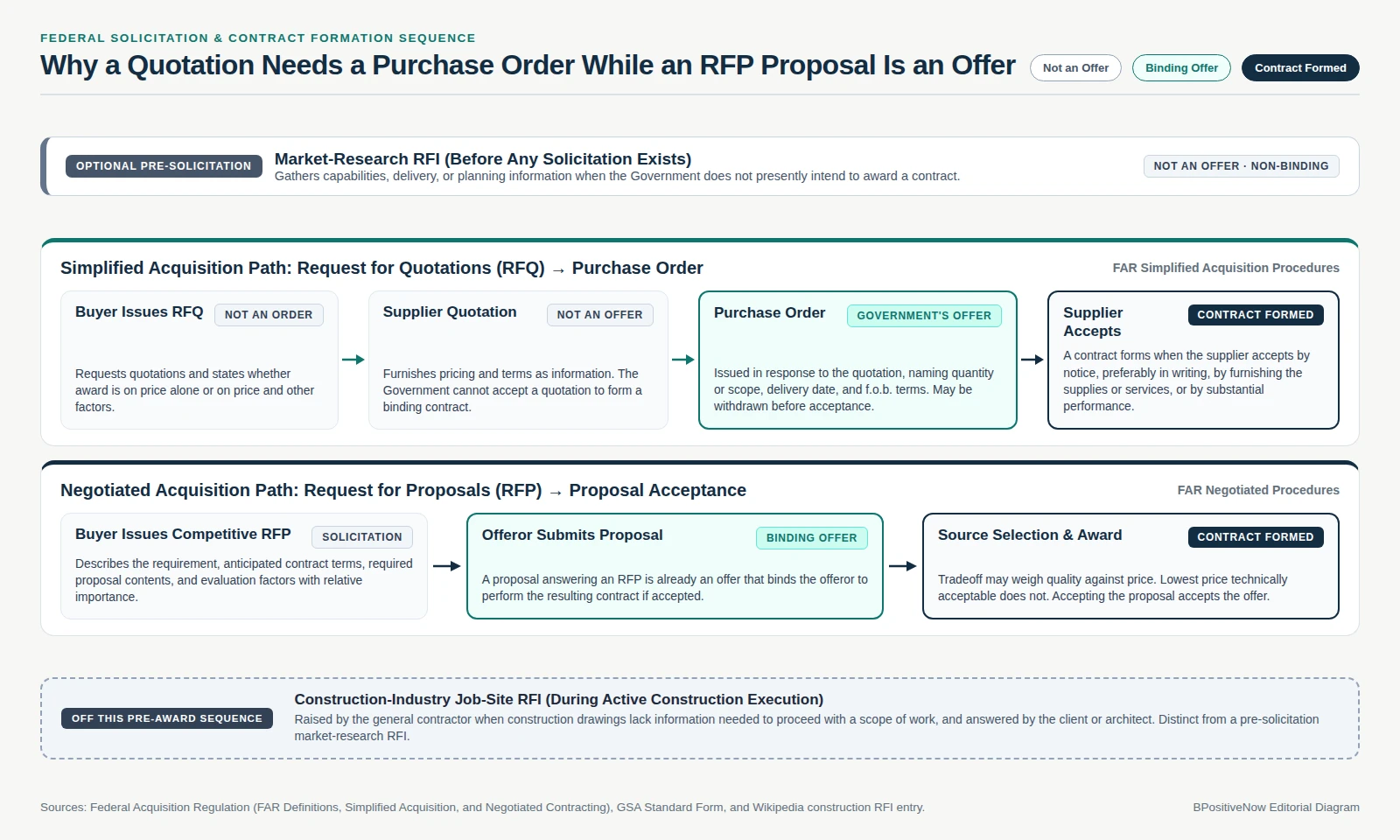
Under FAR 13.004(a), a quotation is not an offer and cannot be accepted by the government to form a binding contract, so issuing a government order in response to a supplier’s quotation does not by itself establish a contract. Instead, FAR 13.004(a) states that the government’s order is an offer to buy certain supplies or services upon specified terms and conditions, and a contract is established when the supplier accepts that offer.
Under FAR 13.004(b), the contracting officer may ask the supplier to indicate acceptance of an order by notification to the government, preferably in writing, or the supplier may indicate acceptance by furnishing the ordered supplies or services or by proceeding with the work to the point where substantial performance has occurred. Because no contract exists prior to supplier acceptance, FAR 13.004(c) allows the government, by written notice to the supplier at any time before acceptance occurs, to withdraw, amend, or cancel its offer.
FAR 2.101 defines a government purchase order as an offer by the government to buy supplies or services, including construction and research and development, upon specified terms and conditions using simplified acquisition procedures. Under FAR 13.302-1(b), a federal purchase order shall specify the quantity of supplies or the scope of services ordered and contain a determinable date by which delivery of the supplies or performance of the services is required.
On the negotiated acquisition path under FAR 15.203(a), requests for proposals communicate government requirements to prospective contractors and solicit proposals, describing at a minimum the government’s requirement, anticipated contract terms and conditions, required proposal information, and the evaluation factors and significant subfactors with their relative importance. Under FAR 2.101, those proposals are offers that bind the offeror to perform the resulting contract if accepted by the government.
How Do RFQ Evaluation Rules Differ From Tradeoff and LPTA RFPs?
Under FAR 13.106-1, a contracting officer soliciting simplified quotations or offers shall notify potential quoters or offerors of the award basis, which may be price alone or price and other factors such as past performance and quality. Under those simplified procedures in FAR 13.106-1, solicitations are not required to state the relative importance assigned to each evaluation factor and subfactor, and they are not required to include subfactors. Under FAR 13.106-2(b)(1), the contracting officer has broad discretion in fashioning suitable simplified evaluation procedures, and the evaluation procedures prescribed in FAR Parts 14 and 15 are not mandatory.
Under FAR 15.304(c), price or cost to the government shall be evaluated in every source selection (subject to the exception listed in that paragraph for the Department of Defense, NASA, and the Coast Guard), and product or service quality shall be addressed through one or more non-cost evaluation factors such as past performance, compliance with solicitation requirements, technical excellence, management capability, personnel qualifications, and prior experience. Under FAR 15.304(d), all factors and significant subfactors that will affect contract award and their relative importance shall be stated clearly in the solicitation, while the rating method itself need not be disclosed.
On GSA’s seller guidance page, GSA explains that although cost is important, cost by itself is often not the most important evaluation factor, defining the cost factor as how competitive the cost proposal is considering product and service quality. On that same GSA page, GSA describes technical approach as how well the proposal or bid demonstrates a clear understanding of the government’s needs and the plan to fulfill them, and describes past performance as whether the business or proposed team has completed projects of similar scope and size.
Under FAR 15.101, an agency can obtain best value in negotiated acquisitions using one or a combination of source-selection approaches, with FAR 15.101-1 and FAR 15.101-2 setting opposite rules on price-versus-quality tradeoffs:
Under FAR 15.101-1, a tradeoff process is appropriate when it may be in the government’s best interest to consider award to other than the lowest priced offeror or other than the highest technically rated offeror. A tradeoff solicitation shall clearly state all evaluation factors, significant subfactors, and their relative importance, and state whether all evaluation factors other than cost or price, when combined, are significantly more important than, approximately equal to, or significantly less important than cost or price. Under FAR 15.101-1(c), accepting a higher priced proposal requires that its perceived benefits merit the additional cost, and the rationale for the tradeoffs must be documented in the file.
Under FAR 15.101-2, the lowest price technically acceptable (LPTA) process is appropriate when best value is expected from selecting the technically acceptable proposal with the lowest evaluated price; tradeoffs are not permitted, and proposals are evaluated for acceptability without being ranked on non-cost or price factors. Under FAR 15.101-2(c), except for the Department of Defense, agencies shall use the LPTA process only when the conditions stated in that provision are met, including that the agency can comprehensively and clearly describe minimum requirements in terms of performance objectives, measures, and standards, would realize no or minimal value from a proposal exceeding those minimum requirements, and believes technical evaluation will require no or minimal subjective judgment.
| Federal evaluation dimension | FAR Part 13 Simplified RFQ | FAR 15.101-2 LPTA RFP | FAR 15.101-1 Tradeoff RFP |
|---|---|---|---|
| Legal status of vendor submission | Quotation, not an offer (FAR 2.101, FAR 13.004) | Proposal that is a binding offer (FAR 2.101) | Proposal that is a binding offer (FAR 2.101) |
| Factor weighting in solicitation | Award basis disclosed; stating relative importance of factors or subfactors is not required (FAR 13.106-1) | Evaluates acceptability without ranking non-cost factors (FAR 15.101-2(b)(3)) | All factors, significant subfactors, and their relative importance clearly stated in solicitation (FAR 15.101-1(b)) |
| Price-quality tradeoffs | Broad contracting officer discretion; Part 14 and Part 15 procedures are not mandatory (FAR 13.106-2(b)(1)) | Tradeoffs are not permitted (FAR 15.101-2(b)(2)) | Permitted when perceived benefits merit the additional cost and rationale must be documented (FAR 15.101-1(c)) |
Is an RFP or RFQ the Same as a Sealed Bid?
Under FAR 15.000, a federal contract awarded using procedures other than sealed bidding is a negotiated contract. Sealed bidding sits in a separate statutory lane under FAR 14.101: bids answering an invitation for bids shall be evaluated without discussions, and after bids are publicly opened, an award is made with reasonable promptness to the responsible bidder whose conforming bid is most advantageous to the government, considering only price and the price-related factors included in the invitation.
Under FAR 6.401(a), contracting officers shall solicit sealed bids if four conditions hold: time permits soliciting, submitting, and evaluating sealed bids; award will be made on price and other price-related factors; conducting discussions with responding offerors about their bids is unnecessary; and there is a reasonable expectation of receiving more than one sealed bid. Under FAR 6.401(b)(1), contracting officers may request competitive proposals when sealed bids are not appropriate under those four conditions.
In commercial encyclopedia usage, Wikipedia’s Request for quotation article states that an RFQ generally means the same thing as a call for bids and an invitation for bid. Under FAR 2.101, however, those three instruments carry distinct definitions: an invitation for bids solicits binding sealed bids under Part 14, a request for proposals solicits binding proposals under Part 15, and a request for quotations under simplified acquisition procedures solicits quotations that are not offers.
How Do State, Construction, and University Rules Differ?
In federal construction and design contracting under FAR 36.103, contracting officers shall use sealed bid procedures for a construction contract if the conditions in FAR 6.401(a) apply, unless the contract will be performed outside the United States and its outlying areas. Under FAR 36.103(b), contracting officers shall acquire architect-engineer services by negotiation, selecting sources in accordance with applicable law, FAR Subpart 36.6, and agency regulations.
During active building work, the abbreviation RFI refers to a project execution document rather than a pre-award market survey: in the construction section of Wikipedia’s Request for information article, a construction RFI is raised by the general contractor when a project’s construction documentation lacks information required to proceed with a scope of work, answered by the client or architect, distributed to stakeholders, and generally accepted as a change to the scope of work unless associated costs require further approval. Under FAR 15.201(e), by contrast, a pre-solicitation procurement RFI occurs when no contract award is presently intended and gathers planning capabilities without forming a contract.
State purchasing manuals use different labels for sealed bidding and competitive negotiation: in Wisconsin’s State Procurement Manual PRO-304 and PRO-305, official sealed bidding is commonly referred to as a Request for Bids (RFB) and must be constructed to permit the lowest responsible bid to be the principal basis of award, defining the lowest responsible bidder as the person or firm submitting the competitive bid with the lowest price that meets the solicitation’s specifications. Under Wisconsin PRO-306, Wisconsin uses the RFP process where an award cannot be made strictly on specifications or price and several firms are qualified to furnish the product or service; price is always a material consideration, and the RFP must be constructed so award is based on the most advantageous proposal as judged by an evaluation committee. Wisconsin PRO-303 uses simplified bidding when the estimated cost is less than the minimum of the official sealed bidding threshold, but more than the best judgment threshold, using the total value anticipated for the purchase, and the need cannot otherwise be met on a mandatory contract.
The University of Wisconsin System procurement office lists assistance for a Request for Bid (RFB) and a Request for Proposal (RFP). At the University of Washington Procurement Services page, competitive solicitation is defined as the process of seeking proposals, quotations, or information from suppliers that bid competitively, managed by Procurement Service.
| Procurement regime or reference | Price-focused path | Multi-factor or open-approach path | Key distinction in that source |
|---|---|---|---|
| Federal Acquisition Regulation (FAR Parts 2, 13, 14 & 15) | Part 13 RFQ (non-binding quotation) or Part 14 IFB (binding sealed bid without discussions) | Part 15 RFP (binding proposal evaluated via tradeoff or LPTA) | Under simplified acquisition, the government’s purchase order is the offer and supplier acceptance establishes the contract |
| Wisconsin State Procurement Manual (PRO-303 to PRO-306) | Simplified bidding (PRO-303) and official sealed bidding called Request for Bids or RFB (PRO-304, PRO-305) | Competitive negotiation Request for Proposal or RFP (PRO-306) | RFB awards on lowest price meeting specifications; RFP must be constructed for award on the most advantageous proposal judged by an evaluation committee, with price always a material consideration |
| University of Wisconsin System Procurement | Request for Bid (RFB) | Request for Proposal (RFP) | Lists institutional assistance for RFB and RFP solicitations |
| University of Washington How to Buy | Quotations within competitive solicitation | Proposals and information requests within competitive solicitation | Procurement Service manages competitive solicitation from suppliers that bid competitively |
| Wikipedia Procurement & Construction Entries | Commercial RFQ on known specifications for standardized items | Commercial RFP giving suppliers flexibility to propose an original product or service | Pre-solicitation RFI is non-binding market inquiry; construction-industry RFI clarifies missing construction documentation during project execution |
What Terms Should You Check Before Accepting a Quote?
Before agreeing to make a purchase, the University of Washington’s How to Buy guide tells buyers to review quotes and proposals from suppliers to understand payment-in-advance requirements (which state procurement law does not allow), the cancellation process, and any restock or cancellation fees, and to ask the supplier if those terms are missing from the quote or proposal.
On a federal simplified-acquisition purchase order, FAR 13.302-1(b)(4) requires specifying f.o.b. destination for supplies delivered within the United States, except Alaska or Hawaii, unless valid reasons support another delivery term. When a supplier quotation covers imported machinery and you need to itemize ocean or air carriage, customs valuation, import duties, and post-arrival commissioning charges, see our guide to the total cost of importing industrial equipment.