University research reaches real-world use through six main routes: licensing, spinout companies, industry collaboration, consulting, graduates and researcher mobility, and open publication; only some run through a technology transfer office. Mistaking a patent, a license or a new company for a finished product leads researchers, firms and funders to back the wrong route and overstate what research delivered.
This Progress explainer covers how each route works, what follows an agreement, and which evidence shows use.
| Item | What it means | Source or condition |
|---|---|---|
| Licensing | The rights owner permits another organization to use research IP on agreed terms; ownership stays with the licensor | WIPO; scope, fees and territory are negotiated |
| Spinout | A new company built on technology developed at a university | WIPO; the company typically needs a license or assignment of the IP |
| Industry collaboration | Joint, sponsored or contract research with a firm | WIPO, OECD; ownership, access and publication terms are set by agreement |
| Consulting | Researchers supply expertise to an outside organization | WIPO; permitted within institutional policy and conflict rules |
| Graduates and mobility | People carry methods and know-how into firms and public bodies | OECD; effects are hard to separate from general education |
| Open publication | Results become available for others to read, test and apply | WIPO, OECD; access alone is not evidence of use |
| Technology transfer office (TTO) | University unit managing invention disclosures, IP protection, licensing and spinouts | WIPO; names and remit vary by institution |
| Evidence of success | Outputs such as patents and agreements, tracked separately from adoption and effects | Adapted from NIST’s 2019 evaluation framework; not a standard score |
Six routes from the lab to the outside world
The World Intellectual Property Organization’s technology transfer guidance lists ten channels for academic knowledge, from publications and consultancy to students entering the workforce and new companies. A 2019 OECD report on university–industry collaboration groups them similarly. Six routes cover most of them.
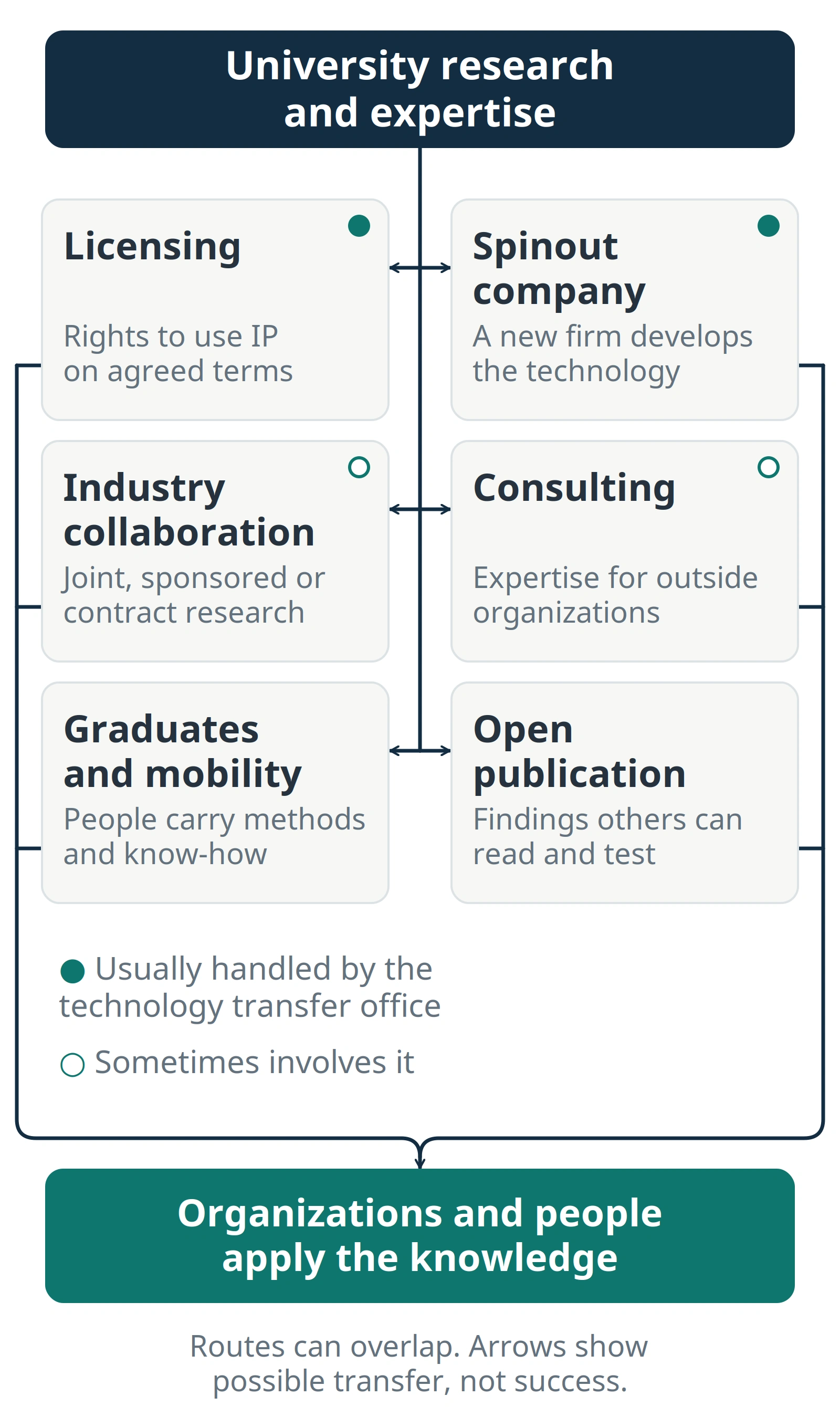
Licensing. A license is a contract in which the owner of the intellectual property (IP) permits another party to use it within stated terms, such as field of use and territory, without transferring ownership. An assignment transfers ownership permanently.
Spinouts. A spinout is a new company formed to develop technology created at a university. WIPO notes that spinouts are often owners or exclusive licensees of the underlying IP, under a negotiated agreement. Building the company itself is a business problem of the kind our Business section covers.
Industry collaboration. In collaborative research, the university and its partner pool staff, facilities, money and existing IP, and agree in advance who owns, uses and commercializes results. A sponsor funds research for preferential access without necessarily taking part; in contract research a company commissions work toward its own goal and typically owns the results.
Consulting. Researchers provide expertise to outside organizations, often personally, where university policy allows; IP ownership depends on that policy and the contract.
Graduates and researcher mobility. The OECD treats graduates joining industry and researchers moving between universities and firms as formal transfer channels. An engineer trained in a research group can bring a method into a plant without any patent or license.
Open publication. Articles, datasets and conference talks let others find, test and apply results. WIPO notes that open publication is sometimes the best way to spread knowledge; in other cases, protection and transfer to a capable company work better.
Which route matters most depends on the field. Studies cited by the OECD found patenting and licensing very important in materials science and chemical engineering but much less so in computer science, while contract and collaborative research and graduate flows were very important in engineering.
Common mistake: Assuming a company founded by researchers owns their university work. Forming a company and holding the IP are separate; the rights usually have to be licensed or assigned.
Takeaway: Licensing and spinouts suit protectable technologies, while methods and know-how often travel through people, collaboration and publication.
What a technology transfer office does
The technology transfer office handles the IP-based routes. WIPO lists its core functions as raising IP awareness, managing invention disclosures, filing for protection, negotiating licenses, creating spinouts, maintaining and enforcing IP, sharing revenue with inventors and managing conflicts of interest. Some also run consultancy or contract research, and names vary.
Not every route runs through a license deal; a graduate taking a job or a published paper usually involves none. Whether a paper first needs an invention disclosure, confidentiality check or IP review depends on institutional policy and any research agreement; consulting and company roles usually fall under institutional rules.
Who owns a result determines which deals are possible. According to WIPO, ownership depends on national IP law, the institution’s IP policy and agreements among the university, creators and any sponsors. In the United States, for example, the Bayh-Dole provisions of federal patent law let nonprofits, including universities, and small businesses elect to retain title to inventions made under federal funding agreements, subject to conditions such as a government license and, for nonprofits, royalty sharing with inventors (2024 edition of the U.S. Code). Other countries use different rules.
Takeaway: Before assuming who can license or commercialize a result, check the governing law, the institution’s policy and the contracts attached to the research.
Why a license or spinout is not yet a product
An agreement moves rights, not finished products. WIPO notes that many university results are “no more than proofs of concept or laboratory-scale prototypes” that need further research and development before they can be commercialized. It also describes a license as becoming an actual transfer only when the licensee learns to use, adapt and improve the technology.
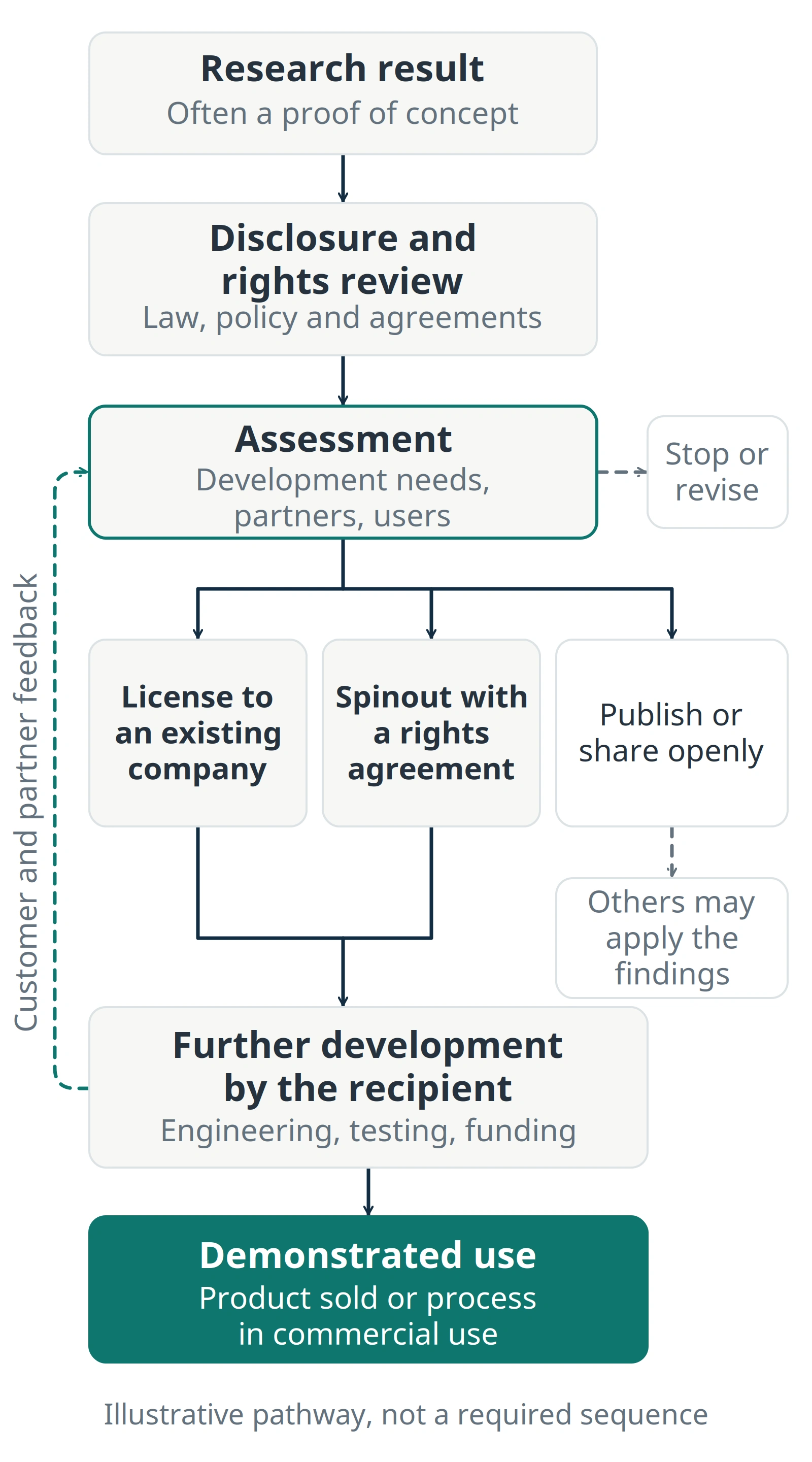
That work usually falls to the recipient, and WIPO lists conditions no IP policy can supply: firms able to invest the money, time and effort to turn IP into marketable products, a market ready to buy, and the capacity to absorb new knowledge. A licensed manufacturing method still has to be engineered into a production line, the kind of shop-floor change covered in our explainer on what digital manufacturing means on the factory floor.
The U.S. National Science Foundation’s I-Corps program is a seven-week course in which research teams engage prospective customers and partners to judge whether a technology could become a product, process or service; national teams must complete at least 100 potential-customer interviews. The training is an evaluation step, not evidence that a product followed.
Common mistake: Counting patents or signed licenses as adoption. A patent claims an invention and a license grants permission; neither shows anyone is using it.
Takeaway: After any agreement, ask who will develop the technology, who will buy or use it, and what evidence of demand exists.
How to tell whether research reached real-world use
A clearer test separates four layers. The National Institute of Standards and Technology’s 2019 Return on Investment Green Paper, written for federal laboratories, proposes evaluating technology transfer through the processes of transfer offices, the outputs of their actions, the outcomes when outsiders adopt those outputs, and broad impacts on industry, the economy and society. Applying that chain to universities is our editorial adaptation; the paper was a discussion document, not a rule.
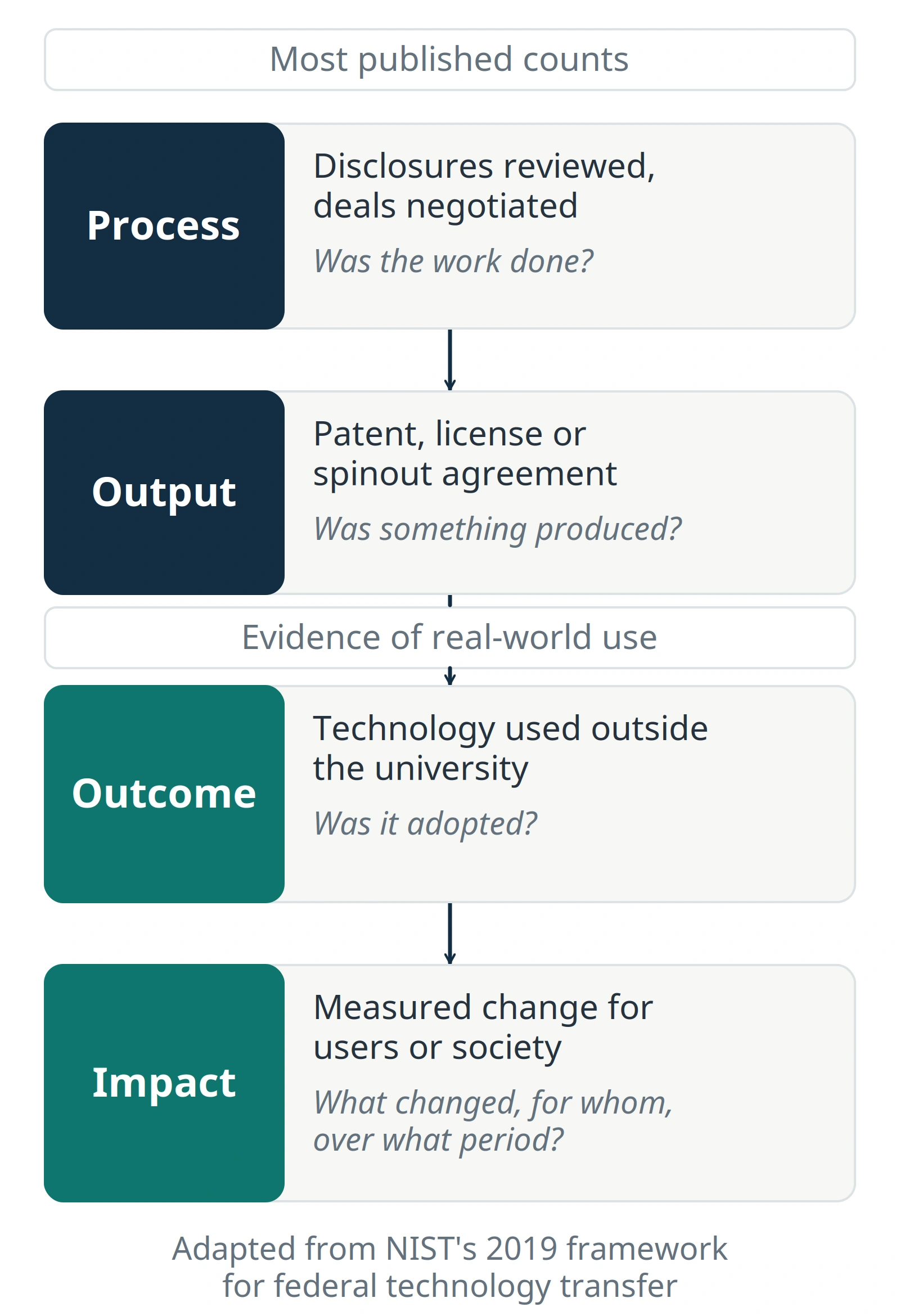
Most published university figures sit in the output layer. WIPO’s typical benchmarks for transfer offices are counts of disclosures, patent applications and grants, licenses, licensing revenue, start-ups and joint ventures. The definitions behind AUTM’s annual licensing survey, completed by U.S. and Canadian research institutions themselves, show why the fine print matters:
- Licensed technologies that became “available” (sold to the public or in commercial rather than developmental use) are recorded separately from licenses signed.
- License income received is counted separately from external legal fees spent on patents and copyrights, so income is a gross figure, not profit.
- Startups count only if formed specifically to develop a technology licensed from the institution.
- AUTM’s FY2025 U.S. results report nearly 2,000 license amendments (written changes to existing agreements), a sign that licenses need management after signing.
The same distinction applies to every route:
| Route | Evidence of activity | Evidence of use |
|---|---|---|
| Licensing | Signed license, license income | Product sold or process in commercial use |
| Spinout | Company formed, rights agreement | Product or service sold; operations based on the technology |
| Collaboration | Joint project or research contract | Partner applies results in its own products or processes |
| Consulting | Consultancy agreement | Client changes a decision, design or process |
| Graduates and mobility | Graduates hired, researcher placements | Employer evidence that the methods are applied |
| Publication | Papers, citations, downloads | Documented use in practice, products, standards or policy |
The right-hand column is an editorial checklist, not a validated index; measuring impact also needs a baseline and a time period.
Dividing one count by another to get a “conversion rate” does not work: patents, licenses and startups are different units, one invention can carry several licenses, and one year’s outputs may stem from research done years earlier. The OECD notes that contributions from basic research may materialize only in the long term.
Common mistake: Reading licensing income as the value of university research. It is gross income from some IP routes, before costs, and leaves out most noncommercial use.
Takeaway: Before calling a transfer a success, look for outcome evidence: who used the result, since when, with what measured change.
Where this does not hold
- Early-stage research. When a result is far from a usable prototype, no agreement makes it usable; further research may matter more.
- No capable recipient or market. Without firms able to invest, or buyers for the result, licenses and spinouts can stall.
- Field differences. Ranking departments or universities by patent counts ignores disciplines where other routes dominate.
- Attribution. Counts do not show that a university caused downstream gains; informal channels barely appear in the data.
- Jurisdiction. Ownership, inventor and government rights differ between countries and institutions; the U.S. example does not carry over.
- Openness versus protection. Publishing before a patent filing can block patenting in many countries; confidentiality delays wider use.
Takeaway: The six routes describe how research can travel, not how often it succeeds; local conditions decide that.
How we researched this
We used WIPO guidance, the OECD’s 2019 report, NIST’s 2019 Green Paper, AUTM’s FY2025 survey definitions and summary, NSF program pages and the 2024 U.S. Code, accessed October 10, 2026. We excluded institutional success stories, cumulative program totals and trend figures with irreconcilable definitions, and did not review U.S. regulations or non-U.S. laws in detail. Our editorial policy explains how we select sources and handle corrections.
Takeaway: These sources describe channels, definitions and evaluation frameworks, not measured success rates for any route.