
On a factory floor, digital manufacturing changes how production information is captured, tied to a job, delivered to the person who needs it and used to decide what happens next. Treat it as a software purchase rather than a working routine and the risks follow: machine data unconnected to any order, an instruction wrong for the job, an alert no one answers.
| Item | What it means | Source or condition |
|---|---|---|
| Data collection | Machine and process observations tied to a job, lot or asset | Data without context has little value (ISA InTech, 2017) |
| MES / execution | Releasing, tracking and recording production work | Scope differs by product and project |
| Digital work instructions | Procedures at the point of work, with status reported back | Revision and approval control is this article’s suggestion where quality depends on the version used |
| Quality traceability | Links from a job to its material, process and inspection records | Definition used here; compliance is a separate check |
| Maintenance | Condition data informing maintenance decisions | NIST categories; a reading is not a validated prediction |
What “digital manufacturing” covers, and how it differs from smart manufacturing
NIST’s Manufacturing Extension Partnership describes digital manufacturing as an evolving concept spanning robotics, additive manufacturing, augmented reality, big data, simulation and cybersecurity. Adoption among small and medium-sized manufacturers varies: some have implemented these tools, some plan to, and some do not yet see the value.
NIST’s Extended Digital Thread page describes smart manufacturing research as aiming for fully integrated, collaborative systems that respond in near real time to conditions in the factory, the supply network and customer demand.
The sources we read draw no fixed line between the terms. This article’s working distinction: “digital” describes information and tools that support individual tasks, while “smart” stresses integration across systems and responsive decisions. A plant can be highly digital task by task and still far from smart; the Technology section covers the tools and the Industry section other plant-level topics.
Takeaway: Ask which tasks and decisions a “digital manufacturing” proposal changes, because the label alone does not say.
Data collection and MES: from signals to production records
A machine signal becomes useful only when it is tied to something people manage: a job order, a material lot, a piece of equipment. A 2017 article in ISA’s InTech magazine treats production information as events with context, such as an order being released or completed, and argues that data without context has little value.
The ISA-95 standard (also IEC 62264) maps responsibilities. ISA’s public overview describes five functional levels: the physical process (0), sensing and manipulating it (1), monitoring and supervisory control (2), manufacturing operations management, where MES sits (3), and business planning and logistics, including ERP (4). The standard deals mainly with the interface between levels 3 and 4; ISA announced a revised Part 1, ANSI/ISA-95.00.01-2025, in April 2025. The levels describe functions, not a network diagram.
A manufacturing execution system (MES) helps release, track and record production work. A 2020 ISA book announcement frames MES as one application within manufacturing operations management, fitting alongside ERP and product lifecycle management rather than replacing them.
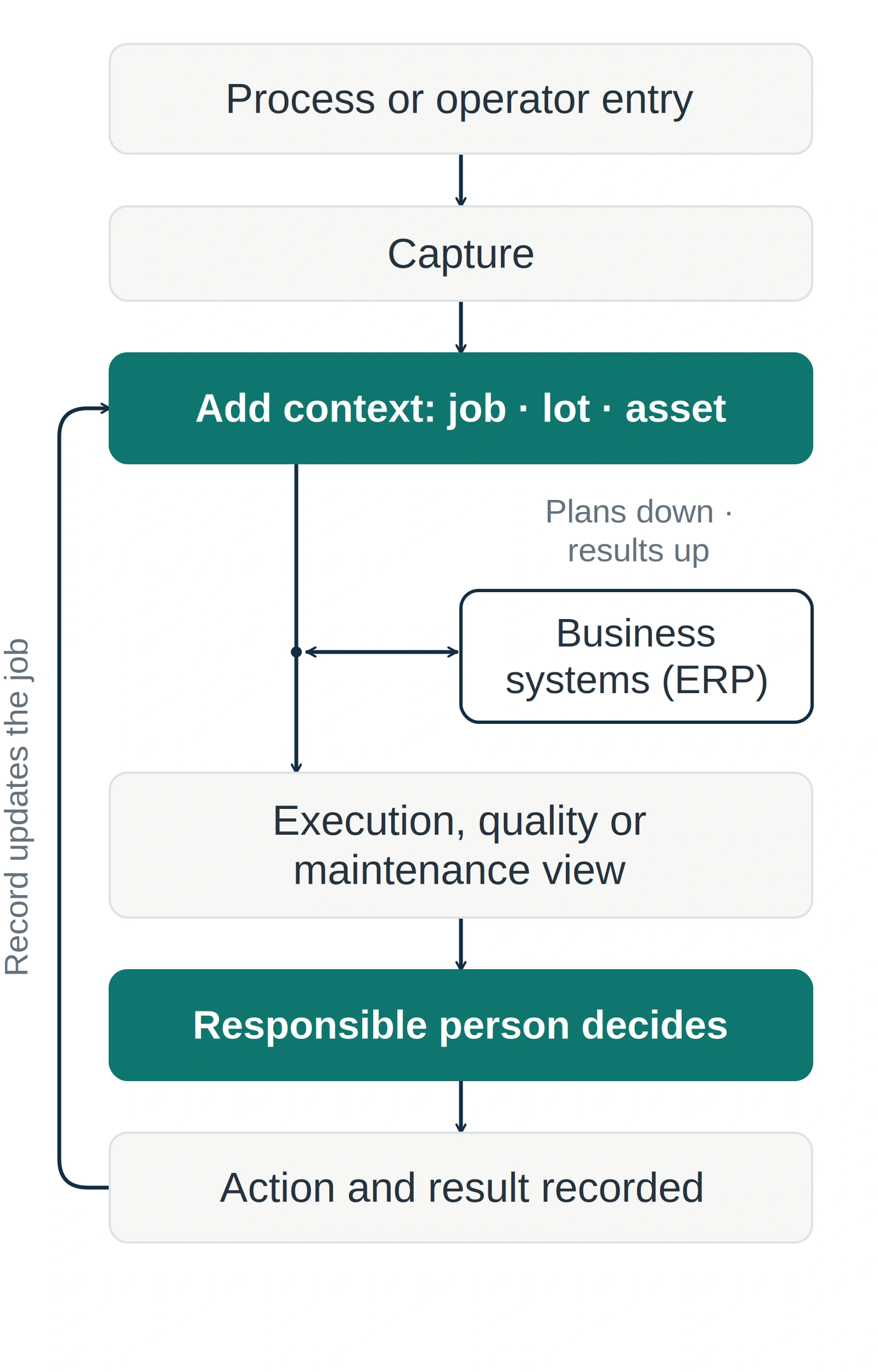
Common mistake: Treating a dashboard as a response. A screen showing a stopped machine changes nothing unless the event reaches a named person with an agreed action.
Takeaway: Before connecting machines, decide which job, lot or asset each signal belongs to and who acts on it.
Digital work instructions: from a file on a screen to a controlled step
MxD, a membership organization that runs manufacturing testbeds, describes a process-manufacturing testbed (project page dated June 2022) whose plan included a mobile-worker proof of concept: operators would receive tasks on a device, open procedures and alerts, do the task and report its status. The page confirms a demonstration platform and software stack were built; it does not report how the mobile-worker functions performed.
The 2017 InTech article describes job orders staged with required documents, such as procedures and checklists, alongside parts and materials at the work location. In this article’s view, a controlled instruction answers three questions: is this the released revision, does it match this job, and did the operator confirm the step? Where software triggers an action, the question of where human approval still matters applies on the floor too.
Common mistake: Scanning paper instructions onto tablets and calling them controlled. Without release and revision rules, a screen shows an outdated version as easily as paper.
Takeaway: Decide whether instructions are reference material or must prove the right version was used, then choose the tool.
Quality traceability: linking a job to its records
Traceability means starting from a product or job and finding its material, processing and inspection records, so an affected batch can be investigated. It depends on reliable links, not data volume.
NIST’s work on supply-chain data trustworthiness, a page it no longer updates, notes that manufacturers, particularly in regulated industries, need data of the correct type and version from the expected sender; tampered or erroneous data can produce weaker or functionally different parts.
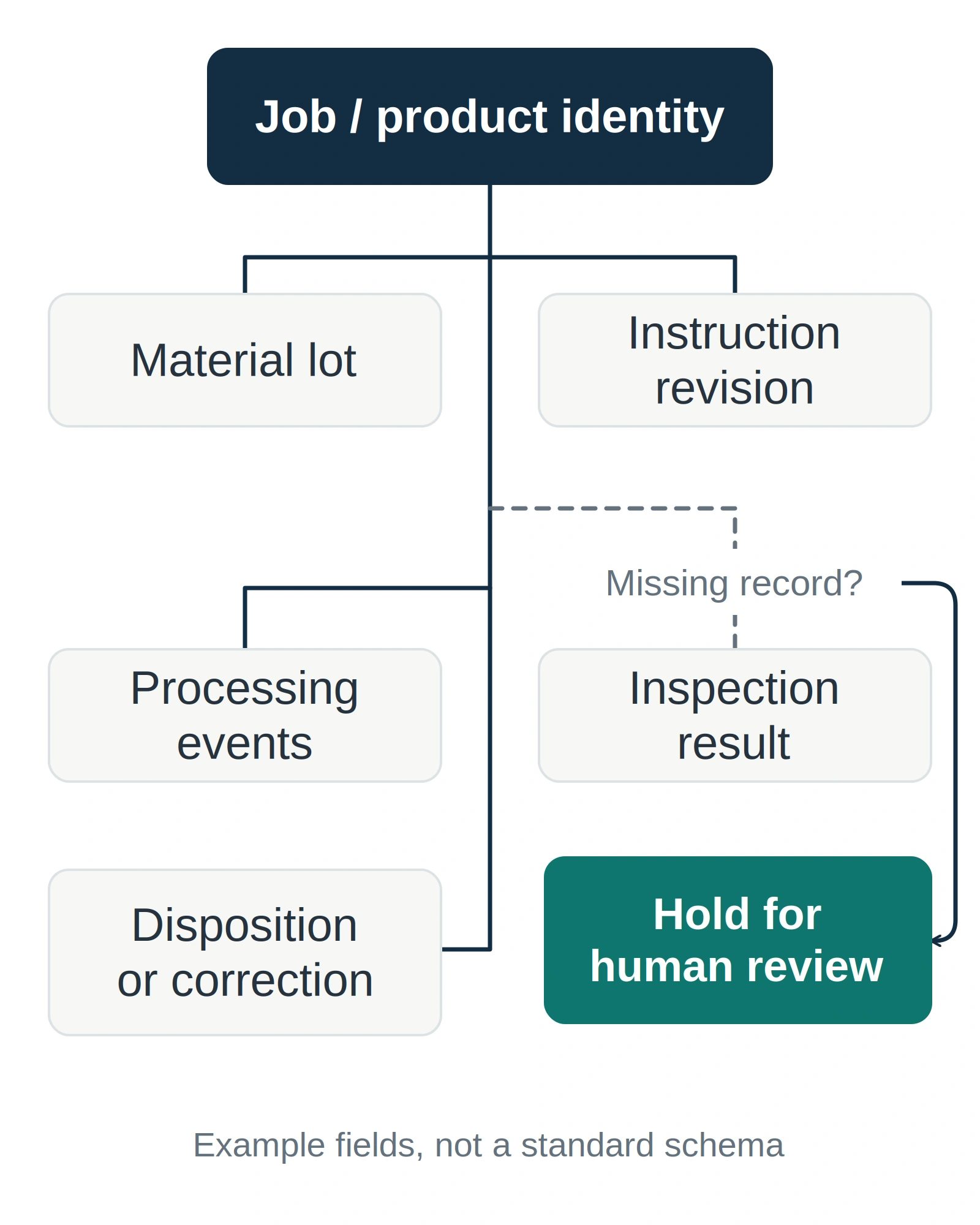
Regulated sectors such as aerospace, pharmaceuticals and food have their own rules on retention, signatures and validation, which we did not research. Moving records to screens does not by itself establish compliance.
Takeaway: Traceability depends on the links between records, so check what happens when one is missing.
Maintenance: from fixed schedules to condition data
NIST’s machinery maintenance research uses three categories: predictive (comparable to condition-based), triggered by failure predictions from data such as temperature, noise or vibration; preventive, following a schedule or cycle count; and reactive, after equipment has failed.
Digital tools mostly change the evidence behind predictive maintenance. The MxD testbed platform, for example, included pressure, level, temperature and wireless vibration sensors, a data historian and asset-monitoring tools.
Common mistake: Assuming connected sensors equal predictive maintenance. A vibration reading becomes a prediction only once its link to a failure mode is established and someone is assigned to act.
Takeaway: Use condition data where it informs a real maintenance decision; keep schedules where no reliable prediction exists.
What implementation actually takes
NIST MEP lists three common challenges: choosing a platform, the initial investment, and poor coordination between departments. NIST’s digital thread project adds that smaller firms have limited resources to integrate lifecycle information.
Plant-floor systems also carry constraints office IT does not: NIST SP 800-82 Rev. 3 (final, September 2023) guides operational technology security while addressing performance, reliability and safety requirements. A draft Revision 4 appeared on September 21, 2026, with comments due November 30, 2026; Revision 3 remains final.
This sequence for a bounded first workflow is our suggested approach, not a standard method:
- Name one decision that is hard to make today.
- Identify the record that would inform it and check it is reliable.
- Agree identifiers and meanings: job, lot, revision, status.
- Assign owners for the instruction, the data, the action and support.
- Trial it with operators, including exceptions, against a prior baseline.
- Review the result and ongoing cost before expanding.
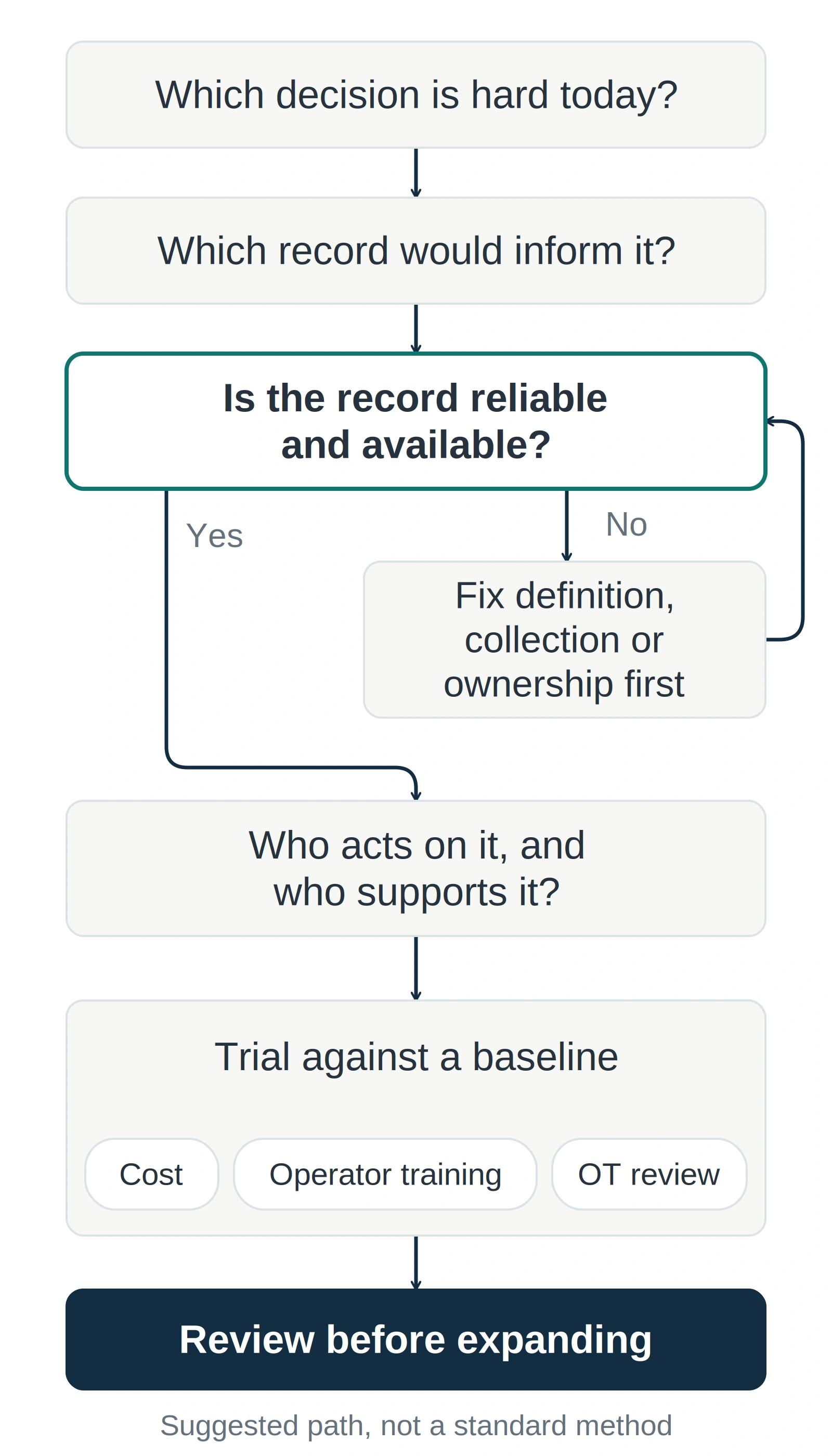
Costs to investigate include interfaces, older-equipment access, data clean-up, instruction upkeep, devices, training and production disruption. We found no verified source for a typical budget, payback period or rollout time. MxD’s testbed shows one way research reaches real-world use, not what a given plant will achieve.
Takeaway: Size the first project to one decision and one record, then expand only when both prove reliable.
Where this does not hold
The changes above break down when:
- Records cannot be linked to a job, lot or asset.
- The workflow is unstable or disputed; digitizing it locks the confusion in.
- Alerts have no owner, or the owner cannot act.
- Business-system integration is postponed, so one order exists in two versions.
- The economics do not justify the scope, such as a rare problem cheaply fixed by hand.
- Operational technology timing, safety or security limits rule out a connection.
Takeaway: If the record, the owner or the response is missing, more software will not supply it.
How we researched this
This explainer draws on public material from NIST, the International Society of Automation and MxD. We did not read the full paid ISA-95 standard or NIST SP 800-82, visit a factory or interview practitioners; our editorial policy explains how we handle sources.
Takeaway: Read this as an orientation to floor-level changes, not a vendor comparison or compliance guide.